Reduced soil quality with cultivation of calcareous soils in subtropical China karst region
DOI:
https://doi.org/10.3986/ac.v54i2.14469Keywords:
Soil quality index (SQI), Minimum data set (MDS), Total data set (TDS), Cultivation, Karst regionAbstract
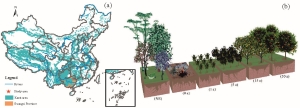
Cultivation practices significantly impact soil functionality and quality, however, the effects of different cultivation durations remain inadequately quantified in the fragile karst ecosystems of southwestern China. This study employed a chronosequence approach to assess agricultural soil quality changes and identify their key drivers. Five land-use stages were selected and sampled: a natural reserve forest (NR) as a reference, recently burned land (0 a), and cultivated lands with durations of 1, 5, 15, and 30 years (1 a, 5 a, 15 a, 30 a, respectively) in the subtropical karst region of southwestern China. The soil quality index (SQI) was constructed using both the Total Data Set (TDS) and Minimum Data Set (MDS) methods. Principal component analysis (PCA) identified calcium (Ca), silt content and silicon (Si) as the key indicators within the MDS. Both TDS and MDS assessments revealed a progressive decline in SQI with increasing cultivation duration following slash-and-burn practices (R²=0.67 between TDS- and MDS-derived SQIs), indicating that agricultural activities significantly alter soil physicochemical properties and lead to soil degradation. The observed decrease in soil quality may be explained by two main mechanisms: (1) depletion of the soil-forming matrix in shallow karst environments; and (2) accelerated loss of acid-insoluble residues due to enhanced weathering under cultivation. These findings highlight the high vulnerability of karst soils to long-term farming, where inherently limited pedogenic materials and intense chemical weathering collectively exacerbate quality decline. This study provides critical insights for developing sustainable land management strategies in karst regions, emphasizing the importance of practices that conserve soil fertility, reduce residue loss, and maintain essential ecosystem services. With the MDS model explaining 67% of the variance in the TDS-based SQI, it represents an efficient and practical tool for monitoring soil quality in fragile karst environments, thereby supporting evidence-based sustainable land use planning.
Downloads
Downloads
Published
How to Cite
Issue
Section
License

This work is licensed under a Creative Commons Attribution 4.0 International License.
Authors guarantee that the work is their own original creation and does not infringe any statutory or common-law copyright or any proprietary right of any third party. In case of claims by third parties, authors commit their self to defend the interests of the publisher, and shall cover any potential costs.
More in: Submission chapter