Factors influencing the groundwater circulation in Mali me Gropa karst massif, Central Albania
DOI:
https://doi.org/10.3986/ac.v54i2.14389Keywords:
MMG karst massif, spring’s regime, effective precipitation, water resources, AlbaniaAbstract
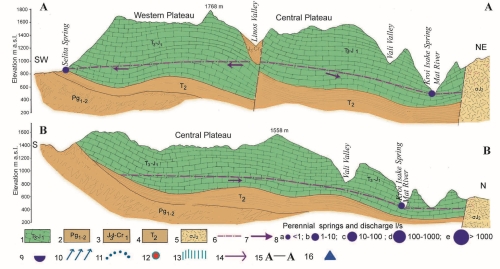
There are 23 carbonate karst areas in Albania with a total area of 6440 km2, or 24% of the country’s territory. Karst aquifers are the richest in the country and about 80% of the water supply for the population living in cities is supplied by karst water. One of the most interesting karst massifs of Albania is called Mali me Gropa (MMG) with a total surface area of 157 km2. It is the subject of this paper. Although this massif has attracted attention due to its exceptional development of surface karst landforms (karst pits, sinkholes, swallow holes) and its large and high-quality groundwater resources, it has not been the subject of comprehensive research. In this paper, for the first time, is a summary of the results of a combination of specialized studies, including geomorphological characterization, analysis of long-term groundwater regime observations in relationship with meteorological data, water balance studies applying the recently developed WaterbalANce software method, assessment of groundwater quality and its variability, determination of the groundwater flow velocity with an artificial tracer, and the use of hydrochemistry and runoff data to determine groundwater flow patterns and sensitivity of spring water to contamination. The results of the multi-method studies conducted on the MMG karst massif will inform future studies of the numerous carbonate karst regions in Albania. A final important objective of this article is to raise public awareness about the vulnerability of karst waters and the need to protect the associated ecosystem, especially now that the MMG karst massif is in the spotlight for tourism development.
Downloads
References
REFERENCES
Abboud, I., 2016. Describe and statistical Evaluation of Hydrochemical data of Karst phenomena in Jordan: Al-Dhaher Cave Karst. Researcher 2014, 5(3): 56-76. https://www.sciencepub.net/researcher
Anonymous., 1992. Geomorphologic map of Albania. Centre of Geographical Studies, Academy of Science of Albania. Printed in Topographic Institute, Tirana.
Aliaj, Sh. 2012. Neotectonic Map of Albania, Printing House KLEAN, Tirana. 292.
Aliaj, Sh., Bushati, S., 2019. Look for the roots of the Mirdita ophiolites (Albania). Journal of Natural & Technical Sciences 2019, 49: 3-47.
Andreychouk, V., Eftimi, R., Nita, J., Klimchouk, A., 2022. Karst relief of the Mali me Gropa Massif, Central Albania. Geological Quarterly, 2022, 66, 6. DOI: http://dx.doi.org/10.7306/gq.1638
Bayari, C.S., Ozyurt, N.N., Ozatan, M., Bastanlar, Y., Varinlioglu, G., Koyuncu, H., Ulkenli, H., Hamarat, S., 2011. Submarine and coastal karstic groundwater discharges along the southwestern Mediterranean coast of Turkey. Hydrogeology Journal (2011) 19: 399-414. DOI 10.1007/s10040-010-0677-y
Bakalowicz, M., 2005. Karst groundwater: a challenge for new resources. Hydrogeology Journal, 13: 148-160. DOI 10.1007/s10040-004-0402-9
Bakalowicz, M., 2015. Karst and karst groundwater resources in the Mediterranean. Environmental Earth Sciences, 74, 5-14.
Benischke, R., Amataj, S., 2002. Tracer experiment in MMG karst massif – Technical data. Institute of Nuclear Physics of Tirana.
Bonacci, O., 2001. Monthly and annual effective infiltration coefficients in Dinaric karst: example of the Gradole karst spring catchment. - Hydrological Science Journal, 46, 2, 287-299, DOI: 10.1080/02626660109492822
Bonacci, O. & Ljubenkov., J. 2005. Karst river Keka hydrology. Proceedings of the International Conference and Field Seminars, Belgrade and Kotor, Eds. Zoran Stevanović and Petar Milanović, 13-22 September 2005, 397-404.
Boni, C., Bono, P., Capelli, G., 1982. Valutazione Quantitta tiva dell’infiltrazione efficace in un bacino carsico dell’Italia Centrale: Confronto con analoghi bacini representativi di diversa litologia. Estrato da:Atti del IIo Simposio Internazionale sulla «Utilizzazione delle aree carsiche» Bari – Castellane Grotte, 20-22 Maggio 1982.
Boussinesq, J., 1877. Essai sur la theorie des eaux courantes (Essay on the theory of running waters). Memoires presentes par divers savants a l’Academie des Sciences de l’Institut National de France XXIII. 1, 252-260.
Chen, Z., Auler, A.S., Bakalowicz, M., Drew, D., Griger, F., Hartmann, J., Jiang, G., Moosdorf, N., Richts, A., Stevanović, Z., Veni, G. & Goldscheider, N., 2017. The World Karst Aquifer Mapping project: concept, mapping procedure and map of Europe. Hydrogeology Journal, 25, 3, 771-785. DOI 10.1007/s10040-016-1519-3
Desio, A., 1960. Manual della Geologia Applicata. Hoepli, Milano.
Denneborg, M., 1993. Albanien expedition 1992 und 1993. Mitteilungen des Verbades der detschen Höflen und Karsifrscher. 39, 4, 64-73.
Doka Dh. Qiriazi P. (2022), The Geography of Albania – Problems and Perspectives. Springer. ISSN 2363-908, ISSN 2363-9091 (electronic).
Drew, D., Hötzl, H., 1999. Karst hydrogeology and human activities: impact, consequences and implications. International Contributions to Hydrogeology, 20, IAH, Balkema, Rotterdam, The Netherlands, pp. 322.
Eftimi, R., 2005. Hydrochemical characteristics of some lithologicaly different karst massifs of Albania. In: Water Resources & Environmental Problems in Karst. In: Stevanovi,ć Z., Milanović, P. Proceedings of the International Conference and Field Seminars 13-19 September, Belgrade 2005, 499-504.
Eftimi, R., 2010. Hydrogeological characteristics of Albania. AQUAmundi Am01012, 79-92. DOI 10.4409/Am-007-10-0012
Eftimi, R., 2020. Karst and karst water resources of Albania and their management. Carbonates and Evaporites, 35, 1-14, DOI 10.1007/s13146-020-00599-0
Eftimi, R., Bisha, G., Tafilaj, I. Sheganaku, Xh., 1985. Hydrogeological Map of Albania, sc. 1:200 000, Tirana. Printed in Nd, Mjeteve Mësimore H. Shijaku, Tirana-Albania.
Eftimi, R., Malík, P., 2019. Assessment of regional flow type and groundwater sensitivity to pollution using hydrograph analyses and hydrochemical data of the Selita and Blue Eye karst springs, Albania. Hydrogeology Journal, 27, 6, 2045-2059; DOI: 10.1007/s10040-019-01974-5
Eftimi, R., Zojer, H., 2015. Human impact on karst aquifers of Albania. Environmental Earth Sciences, 74, 57-70.
Eftimi. R., Benderev, A., 2007. Utilization of hydrochemical data for characterization of the karst system: example of Iskrets spring. Bulgaria Review of the Bulgarian Geological Institute, vol. 68, 1-3, 167-174.
Fiorillo, F., 2014. The recession of spring hydrographs, focused on karst aquifers. Water Resour Manag 28: 1781-1805. https://doi.org/10.1007/s11269-014-0597-z
Fiorillo, F., Revellino, P., Ventafridda, G., 2012. Karst aquifer draining during dry periods. J Cave Karst Stud 74, 2, 148-156. https://doi.org/10.4311/2011JCKS0207
Ford, D., Williams, P., 2007. Karst Hydrogeology and Geomorphology. John Wiley & Sons, Ltd., Chichester, England.
Giacopetti, M., Materazzi, M., Pambianchi, G., Posavec, K., 2017. Analysis of mountain springs discharge time series in the Tennacola stream catchment (Central Apennine, Italy). Environ Earth Sci, 76, 20, https://doi.org/10.1007/s12665-016-6339-1
Gjata, K., Kodra, A., 1999. Albanian ophiolites: from rift to ocean formation. EUG 10: Abstracts. Symp, F04, Petrologic, 405, Strasbourg.
Goldscheider, N., Pronk, M. & Zopfi, J., 2010. New insight into the transport of sediments and microorganisms in karst groundwater by continuous monitoring of particle-size distribution. Geol Croat 63, 2, 157-166.
Gregor, M., Malík, P., 2012. Construction of master recession curve using genetic algorithms. Journal of Hydrology & Hydromechanics, 60, 1, 3-15. DOI 10.2478/v10098-012-0001-8
Gregor, M., Malík, P., 2014. RC 4.0 User’s manual. 36 pp. http://www. hydrooffice.org. Accessed April 2019.
Günay, G. & Ekmekci, M., 1997. Importance of public awareness in groundwater pollution. In: Günai, G., Johnson, K., (eds) Proc. 5th Int Symposium and field seminars on Karst Water & Environmental, Antalya-Turkey, Balkema, Rotterdam, pp 3–10.
Jacobson, R.L., Langmuir, D., 1974. Controls on the quality variations of some carbonate spring water. Journal of Hydrology, 23.
Jaho, S., Mici, A., Boriç, M., Mukeli, R. & R. Naçi, 1984. Climate of Albania (in Albanian), Institute of Hydrometeorology, Tirana.
Hartmann, A., Goldscheider, N., Wagner, T., Lange, J., Weiler, M., 2014. Karst water resources in a changing world: Review of hydrogeological modelling approaches. Review Geophysics, 2014, 52. DOI: 10.1002 / 2013RG000443.
Kalinina, P., 1951. Geotechnical conditions of Selita Spring area (in Russian). Vodokanalproekt, Leningrad.
Kessler, K., 1958. About the possibility increase the water supply capacity of Tirana (in Hungarian). Water Supply Directory, Ministry of Construction, Tirana-Albania.
Kessler, H., 1967. Water balance investigations in the karst regions of Hungary. Act Coll Dubrovnik. AIHS-UNESCO, Paris, 91-105.
Király, L., 2003. Karstification and groundwater flow/speleogenesis and evolution of karst aquifers. In: Gabrovšek F (ed) Evolution of karst: from prekarst to cessation. Zalozba ZRC, Postojna-Ljubljana, Slovenia, pp 155–190.
Kovács, A., Perrochet. P., Király, L., Jeannin, P-Y., 2005. A quantitative method for the characterisation of karst aquifers based on spring hydrograph analysis. Journal of Hydrology 303:152–164. https://doi.org/10.1016/j.jhydrol.2004.08.023
Kogovšek, J., Petrić, M., 2003. Tracing tests as a tool for the estimation of possible impacts of human activities on karst waters – examples from Slovenia. ICGGE Bled 2003.
Kresić, N., Bonacci, O., 2010. Spring discharge hydrograph. chap 4. In: Groundwater hydrology of springs: engineering, theory, management and sustainability. Elsevier, Amsterdam, pp 129–163.
Kresić, N. & Z. Stevanović, Z., 2010. (Eds) Hydrology of Springs: engineering, theory, management and sustainability. Elsevier Inc. BH, Burlington, New York, pp. 736. ISBN: 978-1-85617-502-9
Kristo, V., 1973. Some aspects of karst in Albania (in Albanian). Collection of Studies, 1, 67-79.
Kristo, V., Krutaj, F., Mezini, B., 1987. Karst landscape of Albania and the problems of its rational exploitation (in Albanian). Studime Gjeografike, 2, 257-268.
Krothe, N.C., Libra, R.D., 1983. Sulphur isotopes and hydrochemical variation in spring waters of southern Indiana, U.S.A.- Journal of Hydrology 61, 1, 267-283.
Kullman, E., 1990. Krasovo-puklinové vody. Karst Fissure waters. Geologický ústav Dionýza Štúra, Bratislava, pp. 184.
Kullman, E., 2000. Nové metodické prístupy k riešeniu ochrany a ochranných pásiem zdrojov podzemných vôd v horninových prostrediach s krasovo-puklinovou priepustnosťou [New methods in groundwater protection and delineation of protection zones in fissure-karst rock environment; in Slovak with English summary]. Podzemná voda, 6, 2, 31-41.
Lakey, B., Krothe, N.C., 1996. Stable isotopic variation of storm discharge from a perennial karst spring, Indiana. Water Resource Research 32, 3, 721-731.
Liko, V., 1962. Tectonics and characteristics of the development of Mali me Gropa Region (in Albanian). Bulletin of Tirana University, Natural Sciences, 3, 37-47.
Liso, I.S., Parise, M., 2020. Apulian karst springs: a review. J Environ Science and Engin Technology, 2020, 8, 63-83.
Malík, P., Vojtková, S., 2012. Use of recession-curve analysis for estimation of karstification degree and its application in assessing overflow/underflow conditions in closely spaced karstic springs. Environmental Earth Sciences 2012, 65, 2245–2257. DOI 10.1007/s12665-012-1596-0
Malík, P., 2015. Evaluating discharge regime of karst aquifers, chap 7. 205-250. In: Stevanović Z (ed) (2015) Karst aquifers: characterization and engineering. Professional Practice in Earth Sciences series, Springer, Cham, Switzerland, 687 pp. https://doi.org/10.1007/978-3-319-12850-4
Mammoliti, E., Fronzi, D., Mancini, A., Valigi, D., Tazioli, A., 2021. WaterbalANce, a WebApp for Thornthwaite–Mather Water Balance Computation: Comparison of Applications in Two European Watersheds. Hydrology, 8, 1, pp. 34.
Margat, J., 1998. Les eaux souterraines dans le bassin méditerranéen. Ressources et utilisations. Documents BRGM 282, BRGM, Orléans, France.
Meco, S. & Sh. Aliaj, 2000. Geology of Albania. Gebrüder Borntraeger, Berlin-Stuttgart. 246. ISBN 3-443-11028-2
Newson, M.D., 1971. A model of subterranean limestone erosion in the British Isles based on hydrology. Trans Inst Br Geogr 54, 55-70
Orehova, T., Gerginov, P., 2021a. Analysis of water regime and balance of springs from the Lovech-Tarnovo basin, Bulgaria. International Multidisciplinary Scientific GeoConference: SGEM 2021, 27-34
Orehova, T., Gerginov, P., 2021b. Model study of the regime and balance of karst spring Iskrets, NW Bulgaria. “Climate, atmosphere and water resources in the face of climate change”, vol. 3, 23–29. ISSN 2683-0558
Orehova, T., Toteva, A., Gerginov, P., 2024. Application of Water balance software in the upper Mesta River basin. In: Proc. of the 6-th International scientific “Global Warming’s Imprints on the Elements of the Climatic System”, Hisarya, 24-28 September, 2024. 102-108. ISBN 978-619-92989-0-9
Pali, N., 1973. About the possibility to modify the discharge of the Selita and Shen Maria springs. Ndertuesi, Nr. 2, Tirana, April 1973. 15-22.
Parise, M., Qijiazi, P., Sala, S., 2004. Natural and anthropogenic hazards in karst areas of Albania- Nat. Hazards Earth Syst Sci, 4, 560-581.
Perrin, J., Jeannin, P-Y., Cornaton, F., 2007. The role of tributary mixing in chemical variation at karst springs, Milandre, Switzerland. Journal of Hydrology, 332, 1-2, 158-173.
Radulovic, M., Stevanovic, Z., Radulovic, M., 2012. A new approach in assessing recharge of highly karstified terrains–Montenegro case studies. Environmental Earth Sciences, 65, 2221-2230.
Ravbar, N., Šebela, 2015. S., The effectiveness of protection policies and legislation framework with special regard to karst landscapes: Insights from Slovenia. Environ. Sci. Policy 2015, 51, 106-116.
Qirjazi, P., 2019. Physical Geography of Albania (in Albanian). Mediaprint, Tirana. 580. ISBN: 978-9928-08-415-6
Stevanović, Z., 2015. Ed. Karst aquifers – Characterization and engineering. Professional practice in earth sciences Springer: Heidelberg, Germany, 2015. ISBN 978-3-319-12849-8.
Stevanović, Z., 2019. Kast water in potable water supply: a global scale overview. Environmental Earth Sciences, 2019, 78, 662. https://doi.org/10.1007/s12665-019-8670-9
Stevanović, Z., Eftimi, R., 2010. Karstic sources of water supply for large consumers in south-eastern Europe—sustainability, disputes and advantages. In Proceedings International Interdisciplinary Scientific Conference “Sustainability of the Karst Environment. Dinaric Karst and Other Karst Regions”, September 2009, Plitvice Lakes, Croatia, 23–26. DOI: 104154/gc.2010.15.
Shuster, E.T., White, W.B., 1971. Seasonal fluctuations in the chemistry of limestone springs: a possible mean for characterizing carbonate aquifers. Journal of Hydrology, 14, 93-128.
Thornthwaite, C.W., Mather, J.R., 1957. Instructions and Tables for Computing Potential Evapotranspiration and the Water Balance, Johns Hopkins Univ., Laboratory in Climatology, Baltimore, MD, USA, 10, 181–311.
Turc, L., 1954. The soil balance: relations between rainfall, evaporation and flow (in French). Geography Rev 38, 36-44
White, W.B., 1969. Conceptual models for carbonate aquifers. Ground Water, 7.
White, W.B., 2010. Springwater geochemistry. In: Groundwater hydrology of springs. Kresić, N. & Stevanović, Z., Eds.; Butterworth-Heinemann: Burlington, VT, USA, 2010; pp. 231-268.
Worthington, S.R.H., Ford, D.C. 2009. Self-Organization Permeability in Carbonate Aquifers. Ground Water, 47, 3, 326-336.
Xhomo, A., Kodra, A., Xhafa, Z., Shallo, M., 2002. Geology of Albania, Notes of Geological Map of Albania, sc. 1:200.
(in Albanian). Albanian Geological Service, Tirana. 410
Downloads
Published
How to Cite
Issue
Section
License

This work is licensed under a Creative Commons Attribution 4.0 International License.
Authors guarantee that the work is their own original creation and does not infringe any statutory or common-law copyright or any proprietary right of any third party. In case of claims by third parties, authors commit their self to defend the interests of the publisher, and shall cover any potential costs.
More in: Submission chapter