Formation of clastic sediments in the Atl cave of the Sierra Zongolica, Veracruz Mexico, and their relationship to the soil cover
DOI:
https://doi.org/10.3986/ac.v54i2.14015Keywords:
Mountainous karst, Atl cave, Cave sediments, Sediment formation, Soil cover, Lateral erosionAbstract
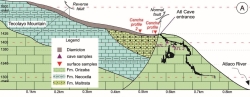
Allochthonous cave sediments contain important paleontological and archaeological records as well as indicators of recent ecological processes. Correct interpretation of these records requires knowledge about the sediment sources and deposition processes, in particular the interrelation of vertical and lateral sediment transport. Compared to platform karst, knowledge about tropical mountainous karstic geosystems is quite limited. To trace the origin and transportation pathways of sediments, we investigated Atl Cave in the Sierra Zongolica Mountain range, Veracruz, Mexico. Field exploration and mapping have shown that the cave presents two horizontal stages representing phreatic conduits and ancient stability stages and is an epigenetic cave with a point recharge zone at the entrance, which is fed by a stream. A comparative study of the surface soil profiles and the diamicton facies of the cave floor deposits included field morphological description, micromorphological observations, grainsize analysis, colorimetry, bulk chemical composition via XRF, and clay mineral identification by XRD. The results demonstrate that the cave deposits have more similarities with the young alluvial and colluvial soils near the entrance than with mature Terra Rossa developed over the limestone formation that hosts the cave. This proves the predominant role of the lateral alluvial transport by high energy events in the formation of the cave diamicton with very restricted contribution of the vertical erosion of Terra Rossa. The main source rock for alluvial and colluvial materials transported to the cave are siliciclastic sediments of the Necoxtla formation, whereas Terra Rossa soils were formed from tephra of the Orizaba volcano. High CIA values, high clay content with a predominance of kaolinite, point to greater weathering of Terra Rossa in comparison with other studied surface and underground materials.
Downloads
Downloads
Published
How to Cite
Issue
Section
License

This work is licensed under a Creative Commons Attribution 4.0 International License.
Authors guarantee that the work is their own original creation and does not infringe any statutory or common-law copyright or any proprietary right of any third party. In case of claims by third parties, authors commit their self to defend the interests of the publisher, and shall cover any potential costs.
More in: Submission chapter