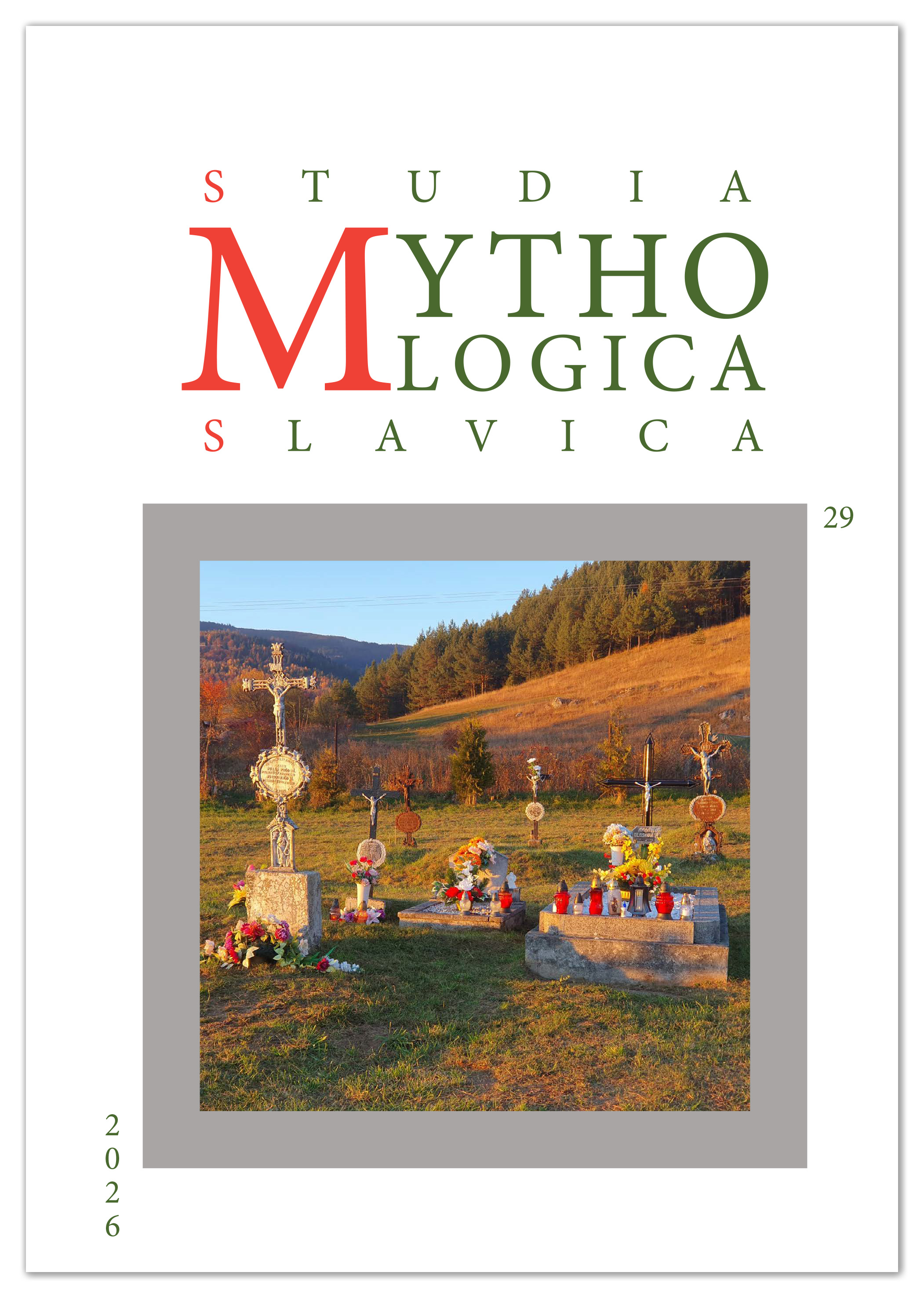
Mrtvi kot ustvarjalci prostora: pokopališča kot čustveni, moralni in ritualni prostori
DOI:
https://doi.org/10.3986/SMS20262904Ključne besede:
pokopališče, delovanje umrlih, pokrajine smrti, kontinuirane vezi, vernakularna religija, prostorska antropologija, SlovenijaPovzetek
Članek obravnava pokopališča v severovzhodni Sloveniji kot pokrajine smrti, v katerih umrli delujejo kot čustveni, moralni in ritualni akterji. Na podlagi desetmesečnega etnografskega terenskega dela, izvedenega leta 2024, raziskava preučuje, kako se odnosi z umrlimi ohranjajo, preoblikujejo ali prekinjajo skozi prostorske prakse in afektivna srečanja. Vsakdanja dejanja skrbi, kot so urejanje grobov in pogovori z umrlimi, ohranjajo pokopališča kot kraje moralne kontinuitete in družinske odgovornosti. Hkrati pa nekatere izkušnje stika z mrtvimi razkrivajo tudi moteče razsežnosti teh vezi, kjer se nerešeni odnosi raztezajo onkraj smrti in zahtevajo ritualno posredovanje. Na pojmovni ravni članek opredeli model kontinuiranih vezi skozi prostorsko perspektivo ter pokaže, da vezi z umrlimi vztrajajo tudi v utelešenih, krajevno umeščenih praksah.
Prenosi
Literatura
Basso, Keith H. 1996. Wisdom Sits in Places: Landscape and Language among the Western Apache. Albuquerque: University of New Mexico Press.
Bender, Barbara. 1993. Landscape: Politics and Perspectives. Oxford, New York: Berg.
Bennett, Gillian. 1999. Alas, Poor Ghost!: Traditions of Belief in Story and Discourse. Logan (UT): Utah State University Press.
Bossuyt, Stijn. 2005. The Liturgical Use of Space in Thirteenth-Century Flanders. In Defining the Holy: Sacred Space in Medieval and Early Modern Europe, eds. Andrew Spicer and Sarah Hamilton, 187–206. Aldershot, Burlington: Ashgate.
Carrassi, Vito. 2023. The Cemetery and the Fear of the Dead. Literatura Ludowa: Journal of Folklore and Popular Culture 67 (1-2): 39–58.
Collins, Catherine Ann and Alexandra Opie. 2010. When Places Have Agency: Roadside Shrines as Traumascapes. Continuum 24 (1): 107–118.
Colombo, Asher D. and Eleonora Vlach. 2021. Why Do We Go to the Cemetery? Religion, Civicness, and the Cult of the Dead in Twenty-First Century Italy. Review of Religious Research 63 (2): 217–243.
Davies, Douglas and Alastair Shaw. 1995. Reusing Old Graves: A Report on Popular British Attitudes. Crayford (Kent): Shaw and Sons.
Davies, Douglas J. 2010. Geographies of the Spirit World. In The Matter of Death: Space, Place and Materiality, eds. Jenny Hockey, Carol Komaromy and Kate Woodthorpe, 208–222. Basingstoke: Palgrave Macmillan.
Day, Abby. 2012. Extraordinary Relationality: Ancestor Veneration in Late Euro-American Society. Nordic Journal of Religion and Society 25 (2): 169–181.
Foltyn, J. L. 2008. Dead Famous and Dead Sexy: Popular Culture, Forensics, and the Rise of the Corpse. Mortality 13 (2): 153–173.
Francis, Doris, Leonie Kellaher and Georgina Neophytou. 2005. The Secret Cemetery. Oxford, New York: Berg.
Gell, Alfred. 1998. Art and Agency: An Anthropological Theory. Oxford: Clarendon Press.
Hallam, Elizabeth and Jenny Hockey. 2001. Death, Memory and Material Culture. Oxford, New York: Berg.
Hallam, Elizabeth, Jenny Hockey and Glennys Howarth. 1999. Beyond the Body: Death and Social Identity. London, New York: Routledge.
Hamilton, Malcolm. 2000. An Analysis of the Festival for Mind-Body-Spirit. In Beyond New Age: Exploring Alternative Spirituality, eds. Steven Sutcliffe and Marion Bowman, 188–200. Edinburgh: Edinburgh University Press.
Heng, Terence. 2020. Interacting with the Dead: Understanding the Role and Agency of Spirits in Assembling Deathscapes. Social & Cultural Geography 23 (3): 400–423.
Hockey, Jenny, Carol Komaromyand and Kate Woodthorpe, eds. 2010. The Matter of Death: Space, Place and Materiality. Basingstoke: Palgrave Macmillan.
Hunter, Alistair. 2016. Deathscapes in Diaspora: Contesting Space and Negotiating Home in Contexts of Post-Migration Diversity. Social & Cultural Geography 17 (2): 247–261.
Ingold, Tim. 1993. The Temporality of the Landscape. World Archaeology 25 (2): 152–174.
Interlocutor SK001, female, 1944, 31.1.2024.
Interlocutor SK009, female, 1930.
Interlocutor SK010, female, 1973, 5.2.2024.
Interlocutor SK016, male, 1962, 10.2.2024.
Interlocutor SK030, male, 1943, 28.2.2024.
Interlocutor SK035, male, 1949, 4.3.2024.
Interlocutor SK038, male, 1961, 6.3.2024.
Interlocutor SK049, male, 1962, 13.3.2024.
Interlocutor SK050, female, 1975, 13.3.2024.
Interlocutor SK052, female, 1978, 25.3.2025.
Interlocutor SK055, female, 1952, 26.3.2024.
Interlocutor SK093, female, 1953, 17.5.2024.
Interlocutor SK094, female, 1988, 17.5.2024.
Interlocutor SK097, female, 1956, 18.5.2024.
Interlocutor SK113, female, 1982, 28.6.2024.
Interlocutor SK145, female, 1952, 18.11.2024.
Ivnik, Tina. 2025. Comforting Dreamscapes: Exploring the Agency of the Dead through Dreams among Spiritual People in Sarajevo, Bosnia and Herzegovina. Folklore: Electronic Journal of Folklore 96: 139–165. DOI: 10.7592/FEJF2025.96.ivnik.
Klass, Dennis. 2006. Continuing Conversation about Continuing Bonds. Death Studies 30 (9): 843–858.
Klass, Dennis and Edith Maria Steffen, eds. 2018. Continuing Bonds in Bereavement: New Directions for Research and Practice. New York: Routledge.
Klass, Dennis, Phyllis R. Silverman and Steven L. Nickman, eds. 1996. Continuing Bonds: New Understandings of Grief. Philadelphia (PA): Taylor & Francis.
Koski, Kaarina. 2018. The Sacred and the Supernatural: Lutheran Church Buildings in Christian Practice and Finnish Folk Belief Tradition. In Storied and Supernatural Places: Studies in Spatial and Social Dimensions of Folklore and Sagas, eds. Ülo Valk and Daniel Sävborg, 54–79. Helsinki: Finnish Literature Society.
Kwilecki, Susan. 2009. Twenty-First-Century American Ghosts: The After-Death Communication – Therapy and Revelation from beyond the Grave. Religion and American Culture 19 (1): 101–133.
Latour, Bruno. 1993. We Have Never Been Modern. Cambridge (MA ): Harvard University Press.
Lindow, John. 2018. Nordic Legends of the Churchyard. In Storied and Supernatural Places: Studies in Spatial and Social Dimensions of Folklore and Sagas, eds. Ülo Valk and Daniel Sävborg, 42–53. Helsinki: Finnish Literature Society.
Low, Setha M. and Denise Lawrence-Zúñiga, eds. 2003. The Anthropology of Space and Place: Locating Culture. Malden (MA), Oxford: Blackwell.
Maddrell, Avril. 2013. Living with the Deceased: Absence, Presence and Absence-Presence. Cultural Geographies 20 (4): 501–522.
Maddrell, Avril and Brenda Mathijssen. 2022. Situating the Dead: Cemeteries as Material, Symbolic, and Relational Space. In The Oxford Handbook of Religious Space, ed. Jeanne H. Kilde, 525–541. Oxford: Oxford University Press. DOI: 10.1093/oxfordhb/9780190874988.013.28.
Maddrell, Avril and James D. Sidaway, eds. 2010. Deathscapes: Spaces for Death, Dying, Mourning and Remembrance. Farnham – Burlington: Ashgate.
Malačič, Janez. 2011. Demographic Situation in Goričko Landscape Park from the Perspectives of Prekmurje and Slovenia. Anali PAZU 1 (2): 155–160.
Mencej, Mirjam. 2015. Security Guards as Participants in and Mediators of a Ghost Tradition. Fabula 56 (1-2): 40–66.
Mencej, Mirjam. 2017. Styrian Witches in European Perspective: Ethnographic Fieldwork. London: Palgrave Macmillan.
Mencej, Mirjam. 2019. The Werewolf as Religious and Ethnic Other in a Herzegovinian Legend. Folklore: Electronic Journal of Folklore 77: 91–114. DOI: 10.7592/FEJF2019.77.mencej.
Mencej, Mirjam. 2025. Uncanny Experience and Its Meaning-Making as Moral Experience. Numen 72: 345–371.
Parker, Julie S. 2005. Extraordinary Experiences of the Bereaved and Adaptive Outcomes of Grief. Omega 51 (4): 257–283.
Primiano, Leonard Norman. 1995. Vernacular Religion and the Search for Method in Religious Folklife. Western Folklore 54 (1): 37–56.
Raahauge, Kirsten Marie. 2016. Ghosts, Troubles, Difficulties and Challenges: Narratives about Unexplainable Phenomena in Contemporary Denmark. Folklore: Electronic Journal of Folklore 65: 89–110. DOI: 10.7592/FEJF2016.65.raahauge.
Valk, Ülo. 2006. Ghostly Possession and Real Estate: The Dead in Contemporary Estonian Folklore. Journal of Folklore Research 43 (1): 31–51.
Walter, Tony. 1996. A New Model of Grief: Bereavement and Biography. Mortality 1 (1): 7–25.
Wojtkowiak, Joanna and Eric Venbrux. 2010. Private Spaces for the Dead: Remembrance and Continuing Relationships at Home Memorials in the Netherlands. In Deathscapes: Spaces for Death, Dying, Mourning and Remembrance, eds. Avril Maddrell and James D. Sidaway, 207–221. Farnham, Burlington: Ashgate.
Woodthorpe, Kate. 2010. Buried Bodies in an East London Cemetery: Re-Visiting Taboo. In Deathscapes: Spaces for Death, Dying, Mourning and Remembrance, eds. Avril Maddrell and James D. Sidaway, 57–74. Farnham, Burlington: Ashgate.
Prenosi
Objavljeno
Kako citirati
Številka
Rubrike
Licenca

To delo je licencirano pod Creative Commons Priznanje avtorstva 4.0 mednarodno licenco.
Avtorji jamčijo, da je delo njihova avtorska stvaritev, da v njem niso kršene avtorske pravice tretjih oseb ali kake druge pravice. V primeru zahtevkov tretjih oseb se avtorji zavezujejo, da bodo varovali interese založnika ter da bodo povrnili morebitno škodo.
Podrobneje v rubriki: Prispevki