
Phytosociological Patterns Along a Soil Nutrient Gradient in Sacred Groves of Haryana
DOI:
https://doi.org/10.3986/hacq-2025-0024Keywords:
Sacred Groves, IVI, soil nutrients, phytodiversity, vegetation compositionAbstract
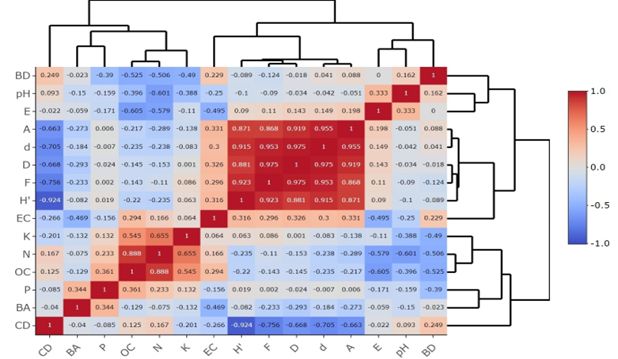
Sacred groves (SGs) are patches of natural vegetation traditionally protected by local communities for religious, cultural, or spiritual reasons. This study evaluated the phytodiversity and soil nutrient profile of four SGs in semi-arid Western Haryana, outside the protected area network. Quadrat sampling recorded floristic composition, species richness, dominance, evenness, and Shannon–Wiener diversity index (H′). Soil parameters included pH, electrical conductivity (EC), bulk density (BD), nitrogen (N), phosphorus (P), potassium (K), and organic carbon (OC). Tree, shrub, and herb density was highest in Bidola SG, while basal area was greater in Sultanpur (19.77 m²/ha) and Dhingsara (15.51 m²/ha) than in Makrana Johra (7.69) and Bidola (4.49). Dominant species were Acacia tortilis (Bidola), Salvadora oleoides (Sultanpur), and invasive Prosopis juliflora (Dhingsara). H′ ranged 0.61–3.26 for trees, 0.05–0.58 for shrubs, 0.39–0.88 for herbs, and 0.32–4.59 for climbers. Soils showed highest EC, N, P, K, and OC in Makrana Johra, maximum BD in Dhingsara, and highest pH in Bidola. Findings highlight that SGs of Western Haryana sustain notable biodiversity and soil fertility, but agricultural expansion threatens their integrity, requiring urgent conservation and community–scientist collaboration.
Downloads
References
Adoum, D. O. N. A. (2024). Floristic structure and diversity of agro-sylvopastoral systems of Batha in Chad. World Journal of Advanced Science and Technology, 5(1), 011-021. https://doi.org/10.53346/wjast.2024.5.1.0028 DOI: https://doi.org/10.53346/wjast.2024.5.1.0028
Akash, A., Navneet, N., & Bhandari, B. S. (2019). A community analysis of woody species in a tropical forest of Rajaji Tiger Reserve. Environment and Ecology. 37 (1): 48—55.
Akindele, T. F., Adekunle, V. A. J., & Lawal, A. (2021). Tree species diversity, abundance, and soil physico-chemical status of PSP 29, Akure Forest Reserve, Ondo State, Nigeria. Journal of Research in Forestry, Wildlife and Environment, 13(4), 120-129.
Arora, J., Manish, K., Nautiyal, D. C., Lakhanpaul, S., & Pandit, M. K. (2024). Changes in vegetation composition and structure following landslide-induced disturbance in the Himalaya. Journal of Asia-Pacific Biodiversity, 17(4), 704-711. https://doi.org/10.1016/j.japb.2024.06.005. DOI: https://doi.org/10.1016/j.japb.2024.06.005
Arshad, F., Haq, S. M., Waheed, M., Jameel, M. A., & Bussmann, R. W. (2024). Environmental variables drive medicinal plant composition and distribution in various forest types of subtropical region in Pakistan. Ecological Frontiers, 44(2), 234-246. https://doi.org/10.1016/j.chnaes.2023.05.004 DOI: https://doi.org/10.1016/j.chnaes.2023.05.004
Bawa, K. S., Kress, W. J., Nadkarni, N. M., Lele, S., Raven, P. H., Janzen, D. H., & Guariguata, M. R. (2004). Sacred groves in the Western Ghats of India: Diversity and conservation implications. Conservation Biology, 18(3), 538–544.
Bhagwat, S. A., Nogué, S., & Willis, K. J. (2014). Cultural drivers of reforestation in tropical forest groves of the Western Ghats of India. Forest Ecology and Management, 329, 393–400. https://doi.org/10.1016/j.foreco.2013.11.017 DOI: https://doi.org/10.1016/j.foreco.2013.11.017
Choudhary, P., Yadav, J. P., & Malik, P. (2015). Sacred groves in conservation of plant biodiversity in Mahendergarh district of Haryana. Research Journal of Agriculture and Forestry Sciences, 3(3), 6–10.
Cottam, G., & Curtis, J. T. (1956). The use of distance measures in phytosociological sampling. Ecology, 37(3), 451-460. DOI: https://doi.org/10.2307/1930167
Curtis, J. T. (1959). The vegetation of Wisconsin: an ordination of plant communities. University of Wisconsin Pres. DOI: https://doi.org/10.2307/jj.36075910
Dar, J. A., Subashree, K., Raha, D., Kumar, A., Khare, P. K., & Khan, M. L. (2019). Tree diversity, biomass and carbon storage in sacred groves of Central India. Environmental Science and Pollution Research, 26(36), 37212-37227. https://doi.org/10.1007/s11356-019-06854-9. DOI: https://doi.org/10.1007/s11356-019-06854-9
Das, P., & Ratha, P. (2013). Sacred groves and indigenous knowledge in Northeast India. International Journal of Biodiversity, 1(2), 78–86.
Deák, B., Tóth, C. A., Bede, Á., Apostolova, I., Bragina, T. M., Báthori, F., & Bán, M. (2019). Eurasian Kurgan Database–a citizen science tool for conserving grasslands on historical sites. Hacquetia, 18(2), 179–187. https://doi.org/10.2478/hacq-2019-0007 DOI: https://doi.org/10.2478/hacq-2019-0007
Deil, U., Frosch, B., Jäckle, H., & Mhamdi, A. (2021). Vegetation and flora of sacred natural sites in North-Western Morocco—landscape context and conservation value. Tools for Landscape-Scale Geobotany and Conservation, 391-422. DOI: https://doi.org/10.1007/978-3-030-74950-7_19
Dhiman, H., Saharan, H., & Jakhar, S. (2020). Floristic diversity assessment and Vegetation analysis of the upper altitudinal ranges of Morni Hills, Panchkula, Haryana, India. Asian J Conserv Biol, 9, 134-142.
Dhiman, H., Saharan, H., & Jakhar, S. (2021). Study of invasive plants in tropical dry deciduous forests–biological spectrum, phenology, and diversity. Forestry Studies, 74(1), 58-71. https://doi.org/10.2478/fsmu-2021-0004 DOI: https://doi.org/10.2478/fsmu-2021-0004
Dhiman, H., Saharan, H., Punia, H., & Jakhar, S. (2024). Floristic status of the Himalayan foothills in Haryana–vegetation composition, diversity and population structure. Forestry Studies, 80(1), 90-109. https://doi.org/10.2478/fsmu-2024-0006 DOI: https://doi.org/10.2478/fsmu-2024-0006
Dove, M. R., Sajise, P. E., & Doolittle, A. A. (Eds.). (2011). Beyond the sacred forest: complicating conservation in Southeast Asia. Duke University Press. DOI: https://doi.org/10.1215/9780822393078
Dudley, N., Bhagwat, S., Higgins-Zogib, L., Lassen, B., Verschuuren, B., & Wild, R. (2012). Conservation of biodiversity in sacred natural sites in Asia and Africa: a review of the scientific literature. Sacred natural sites, 19-32.
Edrisi, S. A., El-Keblawy, A., & Abhilash, P. C. (2020). Sustainability analysis of Prosopis juliflora (Sw.) DC based restoration of degraded land in North India. Land, 9(2), 59. https://doi.org/10.3390/land9020059. DOI: https://doi.org/10.3390/land9020059
Fnd, A., Pardi, F., & Ruziman, H. H. (2024, March). Floristic composition and species diversity at Gunung Inas forest reserve, Kedah, Peninsular Malaysia. In IOP Conference Series: Earth and Environmental Science (Vol. 1316, No. 1, p. 012005). IOP Publishing. https://doi.org/10.1088/1755-1315/1316/1/012005 DOI: https://doi.org/10.1088/1755-1315/1316/1/012005
Forest Survey of India. (2021). India state of forest report (ISFR). https://fsi.nic.in. Accessed 21 January 2025
Gokhale, Y. (2007). Sacred groves of India: An ecological and cultural study. Indian Journal of Ecology, 34(1), 45–58.
Haan, J. D., & Harry, V. (2014). Effects of organic matter input on nitrate leaching and crop yield in arable and vegetable cropping on sandy soil in the Netherlands. In CMdS Cordovil. The Nitrogen challenge: building a blueprint for nitrogen use efficiency and food security. Proceedings 18th Nitrogen Workshop. Lisbon Portugal (pp. 30-6). http://www.nitrogenworkshop.com/#/abstracts/4585708037. Accessed 21 January 2025
Habib, G., Khan, N. A., Sultan, A., & Ali, M. (2016). Nutritive value of common tree leaves for livestock in the semi-arid and arid rangelands of Northern Pakistan. Livestock Science, 184, 64-70. DOI: https://doi.org/10.1016/j.livsci.2015.12.009
Harikesh, (2022). Ecological studies on the community forests of southwestern Haryana (Doctoral dissertation, Kurukshetra University, Kurukshetra). http://hdl.handle.net/10603/421628.
Harikesh, H., & Jakhar, S. (2020). Floristic diversity and vegetation analysis of the community forests of South-West Haryana, India. Current Botany, 11, 51-59. https://doi.org/10.25081/cb.2020.v11.6032 DOI: https://doi.org/10.25081/cb.2020.v11.6032
Hill, D. A. (Ed.). (2005). Handbook of biodiversity methods: survey, evaluation and monitoring. Cambridge University Press. DOI: https://doi.org/10.1017/CBO9780511542084
Himanshi, Harikesh, Jakhar, S. (2021). Analysis of Functional Leaf Trait Variation among the Dominant Understorey Species in the Pine Forest of Morni Hills, Panchkula, Haryana. Journal of Tropical Life Science, 11(2), 233–240. https://doi.org/10.11594/jtls.11.02.13 DOI: https://doi.org/10.11594/jtls.11.02.13
Iftikhar Hussain, M., El-Keblawy, A., & Tsombou, F. M. (2019). Leaf age, canopy position, and habitat affect the carbon isotope discrimination and water-use effciency in three c3 leguminous prosopis species from a hyper-arid climate. Plants, 8, 1-11.https://doi.org/10.3390/plants8100402 DOI: https://doi.org/10.3390/plants8100402
Ishii, H. T., Manabe, T., Ito, K., Fujita, N., Imanishi, A., Hashimoto, D. & Iwasaki, A. (2010). Integrating ecological and cultural values toward conservation and utilization of shrine/temple forests as urban green space in Japanese cities. Landscape and Ecological Engineering, 6(2), 307–315. https://doi.org/10.1007/s11355 DOI: https://doi.org/10.1007/s11355-010-0104-5
IUCN. (2009). Indigenous and community conserved areas. https://www.iucn.org/about/union/commissions/ceesp/topics/governance/icca/index.cfm. Accessed 21 January 2025
Jackson, M. L. (1973). Soil chemical analysis, pentice hall of India Pvt. Ltd., New Delhi, India, 498, 151-154.
Joshi, R. K., & Garkoti, S. C. (2020). Litter dynamics, leaf area index and forest floor respiration as indicators for understanding the role of Nepalese alder in white oak forests in central Himalaya, India. Ecological Indicators, 111, 106065. https://doi.org/10.1016/j.ecolind.2020.106065. DOI: https://doi.org/10.1016/j.ecolind.2020.106065
Kashian, D. M., Barnes, B. V., & Walker, W. S. (2003). Ecological species groups of landform-level ecosystems dominated by jack pine in northern Lower Michigan, USA. Plant Ecology, 166, 75-91. DOI: https://doi.org/10.1023/A:1023265012964
Kittur, B. H., Swamy, S. L., Bargali, S. S., & Jhariya, M. K. (2014). Wildland fires and moist deciduous forests of Chhattisgarh, India: divergent component assessment. Journal of Forestry Research, 25, 857-866. DOI: https://doi.org/10.1007/s11676-014-0471-0
Klepeis, P., Orlowska, I. A., Kent, E. F., Cardelús, C. L., Scull, P., Wassie Eshete, A., & Woods, C. (2016). Ethiopian church forests: a hybrid model of protection. Human Ecology, 44, 715-730. DOI: https://doi.org/10.1007/s10745-016-9868-z
Kufuor, M., & Omari, M. (2015). Sacred groves in West Africa: Conservation and culture. African Studies Review, 58(2), 25–42.
Kumar, A., & Verma, R. K. (2024). Species composition, diversity and distribution of woody species in a tropical dry deciduous Forest of Jalaun district, Uttar Pradesh, India. J. Indian bot. Soc, 104(2), 78-84. https://doi.org/10.61289/jibs2024.10.12.1212
Leakey, R. R., Tientcheu Avana, M. L., Awazi, N. P., Assogbadjo, A. E., Mabhaudhi, T., Hendre, P. S., ... & Manda, L. (2022). The future of food: Domestication and commercialization of indigenous food crops in Africa over the third decade (2012–2021). Sustainability, 14(4), 2355. DOI: https://doi.org/10.3390/su14042355
Linder, H. P., Lehmann, C. E., Archibald, S., Osborne, C. P., & Richardson, D. M. (2018). Global grass (Poaceae) success underpinned by traits facilitating colonization, persistence and habitat transformation. Biological Reviews, 93(2), 1125-1144. DOI: https://doi.org/10.1111/brv.12388
Lynch, L., Kokou, K., & Todd, S. (2018). Comparison of the ecologi cal value of sacred and nonsacred community forests in Kaboli. Togo. Tropical Conservation Science, 11, 1940082918758273. https://doi.org/10.1177/1940082918758273. DOI: https://doi.org/10.1177/1940082918758273
Ma, J., Tam, C., Li, T., Yu, G., Hu, G., Yang, F., Wang, J., & Wu, R. (2022). Sacred natural sites classification framework based on ecosystem services and implications for conservation. Conservation Science and Practice, 4, e12638. https://doi.org/10.1111/ csp2.12638 DOI: https://doi.org/10.1111/csp2.12638
Mace, G. M., Norris, K., & Fitter, A. H. (2012). Biodiversity and ecosystem services: a multilayered relationship. Trends in ecology & evolution, 27(1), 19-26.https://doi.org/10.1016/j.tree.2011.08.006. DOI: https://doi.org/10.1016/j.tree.2011.08.006
Malik, Z. A., & Haq, S. M. (2022). Soil Chemical Properties-Variation with Altitude and Forest Composition: A Case Study of Kedarnath Wildlife Sanctuary, Western Himalaya (India). Journal of Forest and Environmental Science, 38(1), 21-37.
Manna, S., & Roy, A. (2021). Indian sacred groves: Floristic diversity, Ecology and conservation. International Journal of Chemical and Environmental Sciences, 3(1), 32-45. DOI: https://doi.org/10.15864/268963821834540209
Margalef, R. (1958). Temporal succession and spatial heterogeneity in phytoplankton. DOI: https://doi.org/10.1525/9780520350281-024
McIntosh, R. P. (1962). Raunkiaer's" law of frequency". Ecology, 43(3), 533-535. DOI: https://doi.org/10.2307/1933384
Meena, A., Hanief, M., Bidalia, A., Dinakaran, J., & Rao, K. S. (2016). Structure, composition and diversity of tree strata of semi-arid forest community in Delhi, India. Phytomorphology, 66(3-4), 95-102.
Misra, R. (1968). Ecology work book. Oxford and IBH Publishing Co.
Naveen Babu, K., Harpal, B., & Parthasarathy, N. (2021). Changes in tree diversity and carbon stock over a decade in two Indian tropical dry evergreen forests. Geology, Ecology, and Landscapes, 5(1), 7-18. DOI: https://doi.org/10.1080/24749508.2019.1696157
Nelson, D. W., & Sommers, L. E. (1982). Total carbon, organic carbon, and organic matter. Methods of soil analysis: Part 2 chemical and microbiological properties, 9, 539-579. DOI: https://doi.org/10.2134/agronmonogr9.2.2ed.c29
Neto, C., Cardigos, P., Oliveira, S. C., & Zêzere, J. L. (2017). Floristic and vegetation successional processes within landslides in a Mediterranean environment. Science of the Total Environment, 574, 969-981. http://dx.doi.org/10.1016/j.scitotenv.2016.09.119. DOI: https://doi.org/10.1016/j.scitotenv.2016.09.119
Norman, A. K., Ahmed, M., & El Digair, E. M. (2024). Changes of Tree/shrubs Biodiversity Under Semi-arid Conditions of Sudan, Khartoum State (Eastern Blue Nile). Khartoum State (Eastern Blue Nile)(February 24, 2024). https://doi.org/10.2139/ssrn.4737353. DOI: https://doi.org/10.2139/ssrn.4737353
Oliveira, M. T., Souza, G. M., Pereira, S., Oliveira, D. A., Figueiredo-Lima, K. V., Arruda, E., & Santos, M. G. (2017). Seasonal variability in physiological and anatomical traits contributes to invasion success of Prosopis juliflora in tropical dry forest. Tree Physiology, 37(3), 326-337.https://doi.org/10.1093/treephys/tpw123. DOI: https://doi.org/10.1093/treephys/tpw123
Olsen, S. R. (1954). Estimation of available phosphorus in soils by extraction with sodium bicarbonate (No. 939). US Department of Agriculture.
Phillips, E. A. (1959). Methods of vegetation study.
Pielou, E. C. (1966). Species-diversity and pattern-diversity in the study of ecological succession. Journal of theoretical biology, 10(2), 370-383. https://doi.org/10.1016/0022-5193(66)90133-0 DOI: https://doi.org/10.1016/0022-5193(66)90133-0
Prakash, L., Manikandan, P., & Muthumperumal, C. (2022). Documentation of invasive alien plant species in Anaikatty hills, Coimbatore, Western Ghats. Indian Journal of Ecology, 49(3), 698-702. https://doi.org/10.55362/IJE/2022/3581 DOI: https://doi.org/10.55362/IJE/2022/3581
Pratt, P. F. (1965). Potassium. Methods of soil analysis: Part 2 chemical and microbiological properties, 9, 1022-1030. DOI: https://doi.org/10.2134/agronmonogr9.2.c20
Punia, H., Dhiman, H., Saharan, H. and Jakhar, S. (2022). Floristic Composition and Diversity in Response to Varying Degrees of Disturbance in Tropical Dry Deciduous Forests of Southern Haryana, India. Ecology Environment & Conservation, 28 (4): 2164-2173. DOI: https://doi.org/10.53550/EEC.2022.v28i04.079
Quijas, S., Schmid, B., & Balvanera, P. (2010). Plant diversity enhances provision of ecosystem services: A new synthesis. Basic and Applied Ecology, 11(7), 582-593.https://doi.org/10.1016/j.baae.2010.06.009. DOI: https://doi.org/10.1016/j.baae.2010.06.009
Rajasri, R., Sreevidya, E. A., & Ramachandra, T. V. (2017). Functional importance of sacred forest patches in the altered landscape of Palakkad region, Kerala, India, Journal of Tropical Ecology, 33(6), 379–394. https://doi.org/10.1017/S0266467417000360.
Rashid, I., Haq, S. M., Lembrechts, J. J., Khuroo, A. A., Pauchard, A., & Dukes, J. S. (2021). Railways redistribute plant species in mountain landscapes. Journal of Applied Ecology, 58(9), 1967-1980. https://doi.org/10.1111/1365-2664.13961 DOI: https://doi.org/10.1111/1365-2664.13961
Raunkiær, C., & Stowe, E. (1936). Recherches statistiques sur les formations végétales. United States Forest Service, Division of Silvics.
Ray, R., Sreevidya, E. A., & Ramachandra, T. V. (2017). Functional importance of sacred forest patches in the altered landscape of Palakkad region, Kerala, India. Journal of Tropical Ecology, 33(6), 379-394. https://doi.org/10.1017/S0266467417000360 DOI: https://doi.org/10.1017/S0266467417000360
Rhoades, C. C. (1996). Single-tree influences on soil properties in agroforestry: lessons from natural forest and savanna ecosystems. Agroforestry systems, 35, 71-94. DOI: https://doi.org/10.1007/BF02345330
Scull, P., Cardelús, C. L., Klepeis, P., Woods, C. L., Frankl, A., & Nyssen, J. (2017). The resilience of Ethiopian church forests: interpreting aerial photographs, 1938–2015. Land Degradation & Development, 28(2), 450–458. . https://doi.org/10.1002/ldr. 2633 DOI: https://doi.org/10.1002/ldr.2633
Sen, U. K., & Bhakat, R. K. (2021). Quantitative evaluation of biological spectrum and phenological pattern of vegetation of a sacred grove of West Midnapore District, Eastern India. Asian Journal of Forestry, 5(2). https://doi.org/10.13057/asianjfor/r050206 DOI: https://doi.org/10.13057/asianjfor/r050205
Sherafu, Z., Egigu, M. C., & JM, S. (2024). Floristic Composition, Diversity, and Regeneration of Woody Plant Species of Dabal Forest in Southeastern Ethiopia: Implication for Conservation. Scientifica, 2024(1), 7414375. https://doi.org/10.1155/2024/7414375. DOI: https://doi.org/10.1155/2024/7414375
Simpson, E.H. (1949). Measurement of diversity. Nature, 163: 688. DOI: https://doi.org/10.1038/163688a0
Singh, A. K., Sisodia, A., Sisodia, V., & Padhi, M. (2019). Role of microbes in restoration ecology and ecosystem services. In New and future developments in microbial biotechnology and bioengineering (pp. 57-68). Elsevier. https://doi.org/10.1016/B978-0-444-64191-5.00004-3. DOI: https://doi.org/10.1016/B978-0-444-64191-5.00004-3
Singh, S., Swami, S., Gogoi, J., Dwivedi, D. K., Turkar, G. P., Tamang, B., & Borah, S. K. (2023). Effect of Biochar-Mediated Treatments on the Improvement of Soil Acidity, Crop Performance and Soil Properties. Ama, Agricultural Mechanization in Asia, Africa & Latin America, 54, 13575-13603.
Tang, X., Zhao, X., Bai, Y., Tang, Z., Wang, W., Zhao, Y., ... & Zhou, G. (2018). Carbon pools in China’s terrestrial ecosystems: New estimates based on an intensive field survey. Proceedings of the National Academy of Sciences, 115(16), 4021-4026.https://doi.org/10.1073/pnas.1700291115. DOI: https://doi.org/10.1073/pnas.1700291115
Taylor, D., Kent, M., & Coker, P. (1993). Vegetation description and analysis: a practical approach. The Geographical Journal, 159(2), 237. DOI: https://doi.org/10.2307/3451427
Thomas, G. W. (1996). Soil pH and soil acidity. Methods of soil analysis: part 3 chemical methods, 5, 475-490. DOI: https://doi.org/10.2136/sssabookser5.3.c16
Waheed, M., Haq, S. M., Arshad, F., Bussmann, R. W., Iqbal, M., Bukhari, N. A., & Hatamleh, A. A. (2022). Grasses in semi-arid lowlands—community composition and spatial dynamics with special regard to the influence of edaphic factors. Sustainability, 14(22), 14964. https://doi.org/10.3390/su142214964 DOI: https://doi.org/10.3390/su142214964
Weaver, W. (1963). The mathematical theory of communication. University of Illinois press.
Yatar, C., Thinkampheang, S., Sungkaew, S., Wachrinrat, C., Asanok, L., Kamyo, T., ... & Marod, D. (2024). The dynamics of Deciduous Dipterocarp Forest in relation to climate variability in the Sakaerat Biosphere Reserve, Northeastern Thailand. Biodiversitas Journal of Biological Diversity, 25(7). https://doi.org/10.13057/biodiv/d250730 DOI: https://doi.org/10.13057/biodiv/d250730
Downloads
Published
How to Cite
Issue
Section
License
Copyright (c) 2025 ZRC-SAZU

This work is licensed under a Creative Commons Attribution 4.0 International License.
Authors guarantee that the work is their own original creation and does not infringe any statutory or common-law copyright or any proprietary right of any third party. In case of claims by third parties, authors commit their self to defend the interests of the publisher, and shall cover any potential costs.
More in: Submission chapter