Still Reading
An Interview with Joan Copjec
DOI:
https://doi.org/10.3986/fv.46.2.10Keywords:
psychoanalysis, feminism, sexual difference, the uncanny, Abbas KiarostamiAbstract
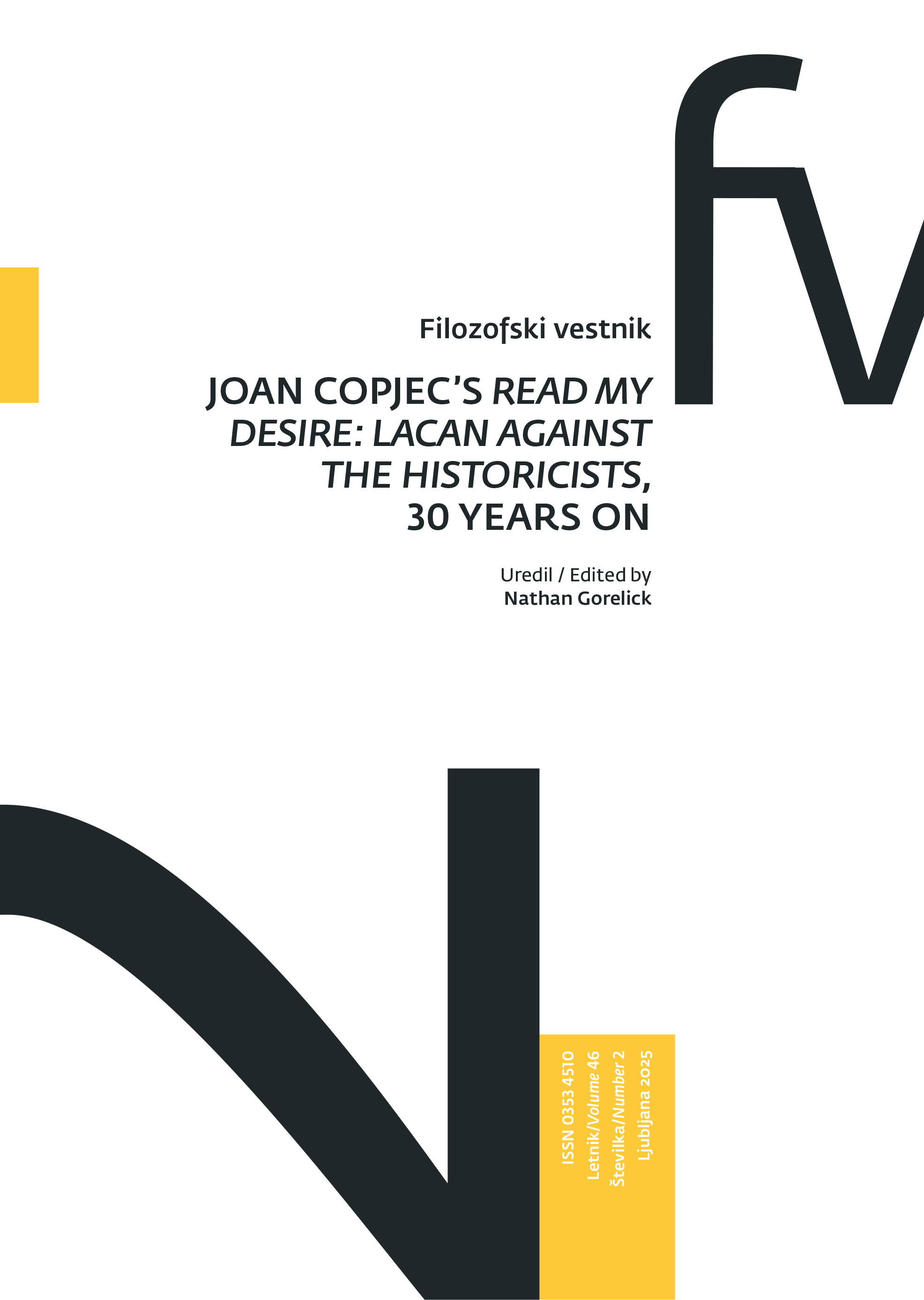
The following is a retrospective interview with Joan Copjec on her formative 1994 book, Read My Desire: Lacan Against the Historicists. The interviewer asks Copjec to reflect on the political and academic context surrounding the book’s initial publication, her personal inspiration for writing it as she did, and its enduring relevance after thirty years.
Copjec also situates Read My Desire with respect to her recent work concerning the films of Abbas Kiarostami; the changed cultural and intellectual status of psychoanalysis today; the uncanny dimension of American electoral politics and the unthought fantasies that structure it; and the history of the relation between psychoanalysis and Islam. The interview concludes with some indication of where Copjec’s research, teaching, and writing are headed now and into the future.
Downloads
References
Cixous, Hélène. “Fiction and Its Phantoms: A Reading of Freud’s *Das Unheimliche* (The ‘Uncanny’).” Translated by Robert Denommé, revised by Eric Prenowitz. In Volleys of Humanity: Essays 1972–2009, edited by Eric Prenowitz, 15–40. Edinburgh: Edinburgh University Press, 2011.
Firestone, Shulamith. The Dialectic of Sex: The Case for Feminist Revolution. New York: Bantam, 1970.
Freud, Sigmund. “The Uncanny (1919).” In An Infantile Neurosis and Other Works (1917–1919), edited by James Strachey, 217–56. Vol. 17 of The Standard Edition of the Complete Psychological Works of Sigmund Freud. London: Hogarth Press, 1974.
Hyldgaard, Kirsten. Sex Education and Other Pedagogical Impossibilities: Lacanian Psychoanalysis and Sexuality Education. London: Palgrave Macmillan, forthcoming 2026.
Lauretis, Teresa de. Technologies of Gender: Essays in Theory, Film and Fiction. Bloomington: Indiana University Press, 1987.
Downloads
Published
How to Cite
Issue
Section
License
Copyright (c) 2026 Authors

This work is licensed under a Creative Commons Attribution-ShareAlike 4.0 International License.
Authors guarantee that the work is their own original creation and does not infringe any statutory or common-law copyright or any proprietary right of any third party. In case of claims by third parties, authors commit their self to defend the interests of the publisher, and shall cover any potential costs.
More in: Submission chapter