Initial steps of insect fossilisation in cave flowstone
DOI:
https://doi.org/10.3986/ac.v55i1.15100Keywords:
actualistic approach, parietal association, sandstone, taphonomyAbstract
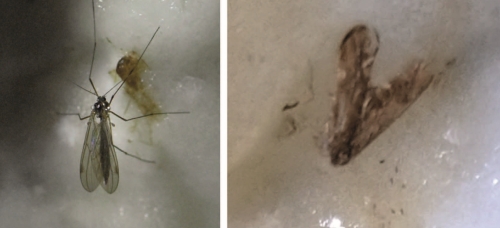
In a small, abandoned coal mine in northeastern Slovenia, there is an area with intensive flowstone deposition. We found about two hundred carcasses of the mosquito Culex pipiens s. l., as well as a few remains of a winter crane fly Trichocera sp., a rove beetle Atheta cf. spelaea, and a false diamondback moth Digitivalva pulicariae on the wall, partly or entirely embedded in the flowstone. We describe the initial taphonomic steps in these carcasses and discuss the probable reasons why the insect remains disintegrate completely, interrupting the process of fossilisation.
Downloads
Downloads
Published
How to Cite
Issue
Section
License

This work is licensed under a Creative Commons Attribution 4.0 International License.
Authors guarantee that the work is their own original creation and does not infringe any statutory or common-law copyright or any proprietary right of any third party. In case of claims by third parties, authors commit their self to defend the interests of the publisher, and shall cover any potential costs.
More in: Submission chapter