Seasonal control of cave microclimate by surface conditions: evidence from a density-driven exchange flow in Samograd Cave (Croatia)
DOI:
https://doi.org/10.3986/ac.v55i1.15079Keywords:
cave microclimate, bimodality, winter ventilation, density-driven circulation, Dinaric karstAbstract
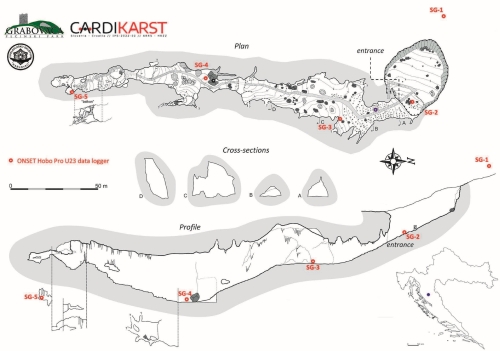
This study investigates the seasonal microclimate dynamics of Samograd Cave (Croatia), a vadose karstic cave characterized by a single large entrance, a concave longitudinal profile, and active atmospheric coupling with the surface. Continuous air-temperature monitoring using data loggers was conducted along a surface-entrance-interior transect at five fixed locations over the period December 2022 – February 2024, covering two winters and one warm season. To independently assess ventilation efficiency and confirm microclimatic bimodality, air CO₂ concentrations were measured using a combination of spot monthly measurements along the cave and high-resolution continuous monitoring at the lowest point of the cave. The primary aim of the study was to evaluate how temperature differences between the surface and the cave controls seasonal air circulation and to determine whether air circulation in the cave is governed by temperature- and density-driven exchange flow. Results show that Samograd Cave exhibits a distinctly bimodal microclimate. During the cold season, negative surface-cave temperature differences promote the inflow of cold, dense air, activating an exchange flow that ventilates the cave interior and leads to an evident decrease in CO2 concentrations. In contrast, during the warm season, such circulation is switched off, resulting in thermal stratification, microclimatic stability, and elevated CO2 levels, with the cave acting as an efficient cold-air trap. Statistical analysis of air-temperature variability, surface-cave correlations, and CO2-temperature relationships demonstrates that the magnitude and persistence of seasonal thermal gradients, rather than the frequency of cold events alone, govern ventilation intensity. The combined temperature and CO2 evidence provides robust confirmation of the seasonal coupling between surface conditions and cave microclimate and supports the interpretation of Samograd Cave as a bimodal microclimate system.
Downloads
Downloads
Published
How to Cite
Issue
Section
License

This work is licensed under a Creative Commons Attribution 4.0 International License.
Authors guarantee that the work is their own original creation and does not infringe any statutory or common-law copyright or any proprietary right of any third party. In case of claims by third parties, authors commit their self to defend the interests of the publisher, and shall cover any potential costs.
More in: Submission chapter