Kef El Ghar cave (Taza, Morocco): Geological, hydrological, ecological and cultural significance of a karst geosite
DOI:
https://doi.org/10.3986/ac.v55i1.14888Keywords:
Kef El Ghar cave, natural and cultural heritage, geoheritage, conservation strategies, tourismAbstract
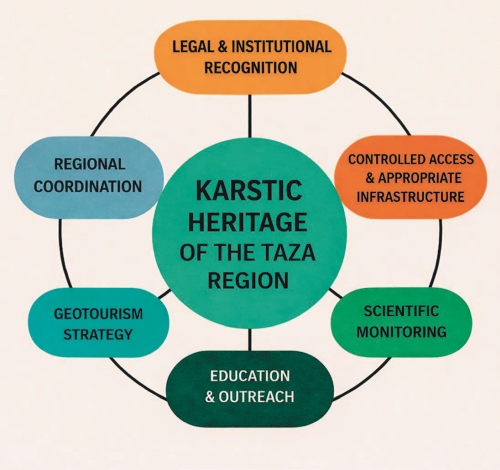
Kef El Ghar cave, located in the Taza region of northeastern Morocco, is a remarkable karst feature of significant natural and cultural value. This study aims to characterize the cave’s geodiversity and assess its significance as a karst geosite. Field investigations and descriptive analyses reveal well-developed karst morphologies, stratigraphic exposures, active hydrological systems, and diverse speleothems, highlighting the cave’s natural significance. In addition, evidence of historical human use, archaeological traces, and aesthetic features emphasize its cultural importance. Despite these attributes, the site faces increasing threats from uncontrolled access, lack of formal protection, and anthropogenic degradation. Based on these findings, this study proposes conservation and management strategies to preserve the cave’s integrity and promote its integration into regional geotourism and public education initiatives. Kef El Ghar cave thus represents a valuable component of the karst heritage of the Taza region and supports initiatives aimed at the establishment of a regional geopark.
Downloads
Downloads
Published
How to Cite
Issue
Section
License

This work is licensed under a Creative Commons Attribution 4.0 International License.
Authors guarantee that the work is their own original creation and does not infringe any statutory or common-law copyright or any proprietary right of any third party. In case of claims by third parties, authors commit their self to defend the interests of the publisher, and shall cover any potential costs.
More in: Submission chapter