A 700 m long pseudokarst cave in calcareous sandstone in the interior of a dolomitic karst cave (Dachstein, Eastern Alps)
DOI:
https://doi.org/10.3986/ac.v55i1.14853Keywords:
Pseudokarst, Piping, Cave sediments, Sandstone, Dolomite cave, Northern Calcareous AlpsAbstract
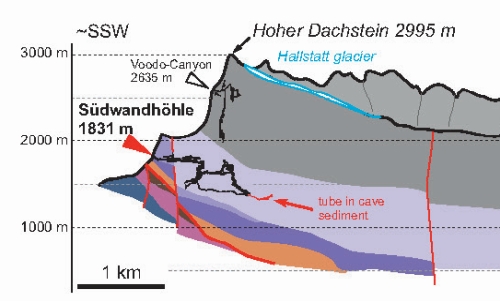
The Südwandhöhle, located in the Dachstein karst massif, is a 12 km long cave system. It is primarily formed in dolomite (Middle Triassic Wetterstein Formation), a rare occurrence in the Northern Calcareous Alps. The cave is 509 m deep and notable for its rock overburden of 1.5 km, and its huge passage cross-sections of up to 250 m². In the remote parts, there is a 0.7 km-long tube that is almost entirely formed in lithified clastic cave sediments. The setting suggests that this relatively small tube (cross-sections: 0.5 to 2 m²) developed as a continuation of a large palaeo-phreatic gallery. The walls and ceilings of the tube are made up of well-lithified sandstone, which often shows erosional features. The sandstone components consist of calcite, partly dedolomite, as well as some quartz, small amounts of dolomite, and iron hydroxide. The cement is calcite, giving a total calcite content of 40–70% in the analysed thin sections. Unusually, the tube does not run along the ceiling of the corridor, as is common in many caves, but winds its way through the large, sediment-filled corridor. As there are no structures in the calcareous sandstone or active tectonics that could have acted as initial fissures, the formation of the proto-conduit is difficult to explain. One possible explanation is that the sand was cemented by pore water from the surrounding dolomite host rock, with parts inside being less lithified or not consolidated at all. Water migrating through this porous sand could have dissolved carbonate grains, and subsequent mechanical erosion and eventually piping could have created a tube. Due to the carbonate content, dissolution probably played only a limited role. Therefore, we interpret this tube as a pseudo-karst cave, that was formed primarily through mechanical erosion of sandstone that had deposited within a karst cave.
Downloads
Downloads
Published
How to Cite
Issue
Section
License

This work is licensed under a Creative Commons Attribution 4.0 International License.
Authors guarantee that the work is their own original creation and does not infringe any statutory or common-law copyright or any proprietary right of any third party. In case of claims by third parties, authors commit their self to defend the interests of the publisher, and shall cover any potential costs.
More in: Submission chapter