Numerical Phytosociological Classification of the Vegetation of the Bozburun Peninsula (Southwestern Anatolia)
DOI:
https://doi.org/10.3986/hacq-2026-0010Ključne besede:
Classification, Mediterranean vegetation, Muğla, numerical analysis, phytosociology, syntaxonomyPovzetek
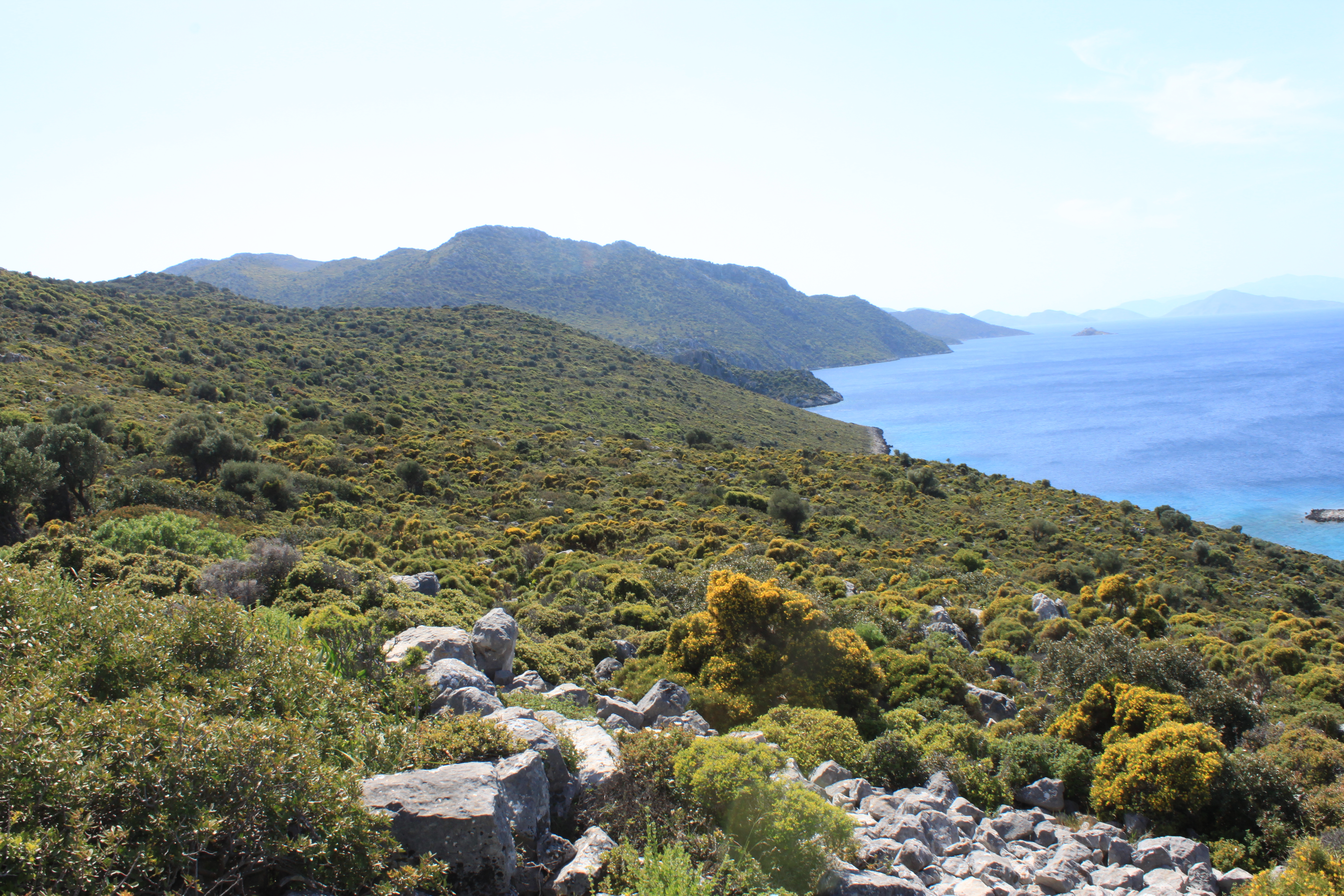
Vegetation patterns of the Bozburun Peninsula (southwestern Anatolia) were investigated using numerical phytosociological methods to classify plant communities and evaluate their relationships with environmental factors. A total of 168 vegetation plots were sampled using the Braun–Blanquet approach. Cluster analysis, Multiple Response Permutation Procedure (MRPP), Indicator Species Analysis (IndVal), and Bray–Curtis polar ordination were applied. Three major vegetation units were identified: phrygana, maquis, and Pinus brutia forests. Ordination analyses showed that elevation and precipitation are the main environmental gradients controlling vegetation distribution. Phrygana occupies lower and drier habitats, maquis occurs under intermediate conditions, whereas Pinus brutia forests are associated with higher and relatively wetter sites. The study also describes three new syntaxa and demonstrates that numerical phytosociological methods provide an effective framework for vegetation classification and syntaxonomical interpretation in southwestern Anatolia.
Prenosi
Literatura
Addicott, E., Laurance, S., Lyons, M., Butler, D., Neldner, J. (2018). When rare species are not important: Linking plot-based vegetation classifications and landscape-scale mapping in Australian savanna vegetation. Community Ecology, 19(1), 67–76. https://doi.org/10.1556/168.2018.19.1.7
Akman, Y. (2011). Climate and bioclimate: Bioclimatic methods and the climates of Türkiye. Palme Press, Ankara. (in Turkish).
Akman, Y., Kurt, L., Demiryürek, E., Quézel, P., Kurt, F., Evren, H., & Küçükoduk, M. (1998). The Pinus brutia communities on ultra-basic and calcareous rocks, in the Marmaris and Bodrum (Muğla) region in the thermomediterranean zone of southwestern Anatolia (Turkey). Ecologia Mediterranea, 24(1), 63–71. (in French).
Anonymous (1998). Land assets of Muğla Province. Ankara Republic of Türkiye Prime Ministry General Directorate of Rural Services Publications, 132 pp. (in Turkish).
Aytepe, H. A. (2026). The vegetation of Karlik mountain in southwestern Turkey. Pakistan Journal of Botany, 58(1), 133-145. http://dx.doi.org/10.30848/PJB2026-1(22)
Aytepe, H. A., & Kavgacı, A. (2025). Syntaxonomical contribution to the vegetation classification of Türkiye from SW Anatolia: A plant diversity hotspot. Šumarski list, 149, 5–6. https://doi.org/10.31298/sl.149.5-6.5
Aytepe, H. A., & Varol, Ö. (2025). Contribution to the study of the Türkiye vegetation: Phytosociology of the Bodrum (Muğla) Peninsula. Phytocoenologia (Early access). https://doi.org/10.1127/phyto/0461
Barbero, M., Bonin, G., Loisel, R., Quézel, P. (1990). Changes and disturbances of forest ecosystems caused by human activities in the western part of the Mediterranean Basin. Vegetatio, 87: 151–173.
Birand, H. (1960). First results of vegetation studies in the Central Anatolian steppe I. Halophyte communities of Lake Tuz. Botanische Jahrbücher, 79, 254–296. (in German).
Bonari, G., Fernández‐González, F., Çoban, S., Monteiro‐Henriques, T., Bergmeier, E., Didukh, Y. P., ... & Chytrý, M. (2021). Classification of the Mediterranean lowland to submontane pine forest vegetation. Applied Vegetation Science, 24(1), e12544. https://doi.org/10.1111/avsc.12544
Braun-Blanquet, J. (1932). Plant sociology. McGraw-Hill, New York, 439 pp.
Çırpıcı, A. (1987). Studies on the flora and vegetation of Türkiye. Doğa – Turkish Journal of Botany, 11(2), 217–232. (in Turkish).
Czeczott, H. (1938–1939). Contribution to the knowledge of the flora and vegetation to Turkey. Feddes Repertorium Beihefte, 107.
Davis, P. H. (1965–1982). Flora of Turkey and the East Aegean Islands (Vols. 1–9). Edinburgh University Press, Edinburgh.
Durmuşkahya, C. (2005). Vegetation ecology of the Lower Gediz Basin (PhD thesis). Celal Bayar University, Institute of Natural and Applied Sciences, Manisa.
Esri. (n.d.). IDW (Spatial Analyst)—ArcMap documentation. ArcGIS Desktop. from (Access date: 15.05.2026, (https://desktop.arcgis.com/en/arcmap/latest/tools/spatial-analyst-toolbox/idw.htm)
Fontaine, M., Aert, R., Özkan, K., Mert, A., Gülsoy, S., Süel, H., Waelkens, M., & Muys, B. (2007). Elevation and exposition rather than soil types determine communities and site suitability in Mediterranean mountain forests of southern Anatolia, Turkey. Forest Ecology and Management, 247(1), 18–25. https://doi.org/10.1016/j.foreco.2007.04.021
Géhu, J. M., Costa, M., Biondi, E., Franck, J., & Arnold, N. (1987). Data on the coastal vegetation of Crete. Ecologia Mediterranea, 13(1), 93–105. https://doi.org/10.3406/ecmed.1987.1615 (in French).
Gillet, F., Rouzet, A., Borcard, D., & Legendre, P. (2025). Rarity and sparseness in plant communities: Impact of minor species removal on beta diversity and canonical ordination. Journal of Vegetation Science, 36(1), e70013. https://doi.org/10.1111/jvs.70013
Handel-Mazzetti, H. F. (1909). Results of a botanical journey to the Pontic Mountains in the Sanjak of Trabzon. Annalen des Naturhistorischen Hofmuseums Wien, 23, 5–212. (in German).
Karaköse, M. (2019). Numerical classification and ordination of Esenli (Giresun) forest vegetation. Biologia, 74, 1441–1453. https://doi.org/10.2478/s11756-019-00321-z
Karaköse, M., & Terzioğlu, S. (2021). Numerical classification and ordination of Finike (Antalya) forest vegetation. Biologia, 76, 3631–3645. https://doi.org/10.1007/s11756-021-00910-x
Kavgacı, A., Balpınar, N., Öner, H. H., Arslan, M., Bonari, G., Chytrý, M., & Čarni, A. (2021). Classification of forest and shrubland vegetation in Mediterranean Turkey. Applied Vegetation Science, 24, e12589. https://doi.org/10.1111/avsc.12589
Kavgacı, A., Šilc, U., Başaran, S., Marinšek, A., Başaran, M. A., Košir, P., Balpınar, N., Arslan, M., Ergüler, Ö., & Čarni, A. (2017). Classification of plant communities along postfire succession in Pinus brutia (Turkish red pine) stands in Antalya (Turkey). Turkish Journal of Botany, 41, 299–307. https://doi.org/10.3906/bot-1609-34
Kaytanlıoğlu, E. H. T., Negiz, M. G., & Gülsoy, S. (2023). The diversity of woody flora in Isparta Gölcük Nature Park and its relationships with environmental variables. Journal of Forestry Research, 10(1), 23–31. https://doi.org/10.17568/ogmoad.1075675 (in Turkish).
Krause, K. (1940). Western and Central Anatolian plant formations (Translated by H. Birand). Ministry of Agriculture Press, 60, 1–29. (in Turkish).
Kurt, E. Ö., & Negiz, M. G. (2018). A study on the classification of woody vegetation in forest ecology (Isparta-Yenişarbademli case). Bilge International Journal of Science and Technology Research, 2(1), 98–109. https://doi.org/10.30516/bilgesci.355493
Kurt, L., Ketenoğlu, A. O., Akman, Y., Özdeniz, E., Şekerciler, F., Bölükbaşı, A., & Özbey, B. G. (2015). Syntaxonomic analysis of the preforest and forest vegetation in the thermo- and eumediterranean zone around Antalya Gulf, Turkey. Turkish Journal of Botany, 39, 487–498. https://doi.org/10.3906/bot-1402-63
Malkoçoğlu, S., Kahveci, E., Kara, Ö. (2025). Vegetation–environment relationships and ecological species groups on the sea-facing slope of the Sandıras mountain mass. In 6. Bilsel International Sumela Scientific Researches Congress, 12–13 April 2025, Trabzon/Türkiye (pp. 314–323). (in Turkish)
Malkoçoğlu, S., Kara, Ö. (2025). Researches on parting of forest site units of Sandıras mountain mass. The Artvin Çoruh University Faculty of Forestry Journal, 26(1), 256–268. https://doi.org/10.17474/artvinofd.1649790 (in Turkish).
McCune B, Mefford M. J. (2011). PC-ORD: Multivariate analysis of ecological data. Version 6.0. MjM Software, Gleneden Beach, Oregon, USA.
McCune, B., Grace, J. B. (2002). Analysis of ecological communities. MjM Software Design.
Meteorology General Directorate (2014). Temperature, precipitation, humidity and wind values of Marmaris between 1967–2015, Muğla. (in Turkish).
MTA (2026). 1/250.000 scales geologic map of Türkiye. (Access date: 06.03.2026, https://www.mta.gov.tr/v3.0/sayfalar/hizmetler/doc/marmaris.pdf)
Myers, N., Mittermeier, R. A., Mittermeier, C. G., da Fonseca, G. A. B., & Kent, J. (2000). Biodiversity hotspots for conservation priorities. Nature, 403, 853–858.
Naveh, Z., Dan, J. (1973). Mediterranean vegetation and grazing impact studies. Israel Journal of Botany, 22: 95–108.
Negiz, M. G., & Erfidan, O. (2024). Vegetation-environment relationships in the Akdağ (Burdur) region. Šumarski list, 148(11–12), 565–576. https://doi.org/10.31298/sl.148.11-12.4
Özdeniz, E. (2019). Syntaxonomic checklist of the vegetation of Turkey; the high-rank syntaxa (AnatoliaVegChecklist-AVC). Fresenius Environmental Bulletin, 28(12), 9129–9139.
Özkan, K. (2009). Environmental factors as influencing vegetation communities in Acipayam District of Turkey. Journal of Environmental Biology, 30(5), 741–746.
Plants of the World Online (POWO). (2026). Facilitated by the Royal Botanic Gardens, Kew. Available at: https://powo.science.kew.org/ (Accessed: 15 May 2026).
Quézel, P., Médail, F. (2003). Ecology and Biogeography of Mediterranean Basin Forest Ecosystems. Springer, Berlin.
Sabatini, F. M., Lenoir, J., Hattab, T., et al. (2021). sPlotOpen: An environmentally balanced, open-access, global dataset of vegetation plots. Global Ecology and Biogeography, 30, 1740–1764. https://doi.org/10.1111/geb.13346
Sağlam, C. (2013). A phytosociological study of the forest, shrub, and steppe vegetation of Kızıldağ and environs (Isparta, Turkey). Turkish Journal of Botany, 37, 316–335. https://doi.org/10.3906/bot-1205-46
Schwarz, O. (1935–1936). The vegetation conditions of Western Anatolia. Botanische Jahrbücher für Systematik, 67(3–4), 297–436. (in German).
Şenel, M., & Bilgin, R. (1997). Geology of Muğla. Geological Maps of Türkiye, MTA Geological Survey Department, Ankara. (in Turkish).
Şık, L., & Gemici, Y. (2010). A phytosociological investigation on the phrygana vegetation of Yunt Mountain (Manisa). Celal Bayar University Journal of Science, 6(2), 121–132. (in Turkish).
Terzioğlu, S., Bilgili, E., Karaköse, M. (2012). Forests of Turkey. General Directorate of Forestry, Department of Foreign Relations, Education and Research. (in Turkish).
van der Maarel, E. (1979). Transformation of cover-abundance values in phytosociology and its effects on community similarity. Vegetatio, 39(2), 97–114. https://doi.org/10.1007/BF00052021
Vural, M., Duman, H., Güner, A., Dönmez, A. A., & Şağban, H. (1995). The vegetation of Köyceğiz-Dalyan (Muğla) specially protected area. Turkish Journal of Botany, 19, 431–476.
Yenipınar, E., Kayhan, M. M., Çubukçu, E. A., Demir, V., Sevimli, M. F. (2021). Estimating long-term precipitation in Turkey using IDW and Kriging methods. Turkish Journal of Remote Sensing, 3(2), 47–52. (in Turkish) https://doi.org/10.51489/tuzal.949782
Yılmaz, C. B., Bodu, H., Yüce, E. S., Demir, V., Sevimli, M. F. (2023). Estimation of Turkey's long-term average temperature (°C) values using three different interpolation methods. Geomatik, 8(1), 9–17. (in Turkish) https://doi.org/10.29128/geomatik.984310
Prenosi
Objavljeno
Kako citirati
Številka
Rubrike
Licenca
Avtorske pravice (c) 2026 ZRC-SAZU

To delo je licencirano pod Creative Commons Priznanje avtorstva 4.0 mednarodno licenco.
Avtorji jamčijo, da je delo njihova avtorska stvaritev, da v njem niso kršene avtorske pravice tretjih oseb ali kake druge pravice. V primeru zahtevkov tretjih oseb se avtorji zavezujejo, da bodo varovali interese založnika ter da bodo povrnili morebitno škodo.
Podrobneje v rubriki: Prispevki