Diversity and botanical characterization of polyfloral honey from Bosnia and Herzegovina
DOI:
https://doi.org/10.3986/hacq-2025-0023Ključne besede:
Melisopalynology, pollen, Shannon-Weaver, Shannon uniformity indexPovzetek
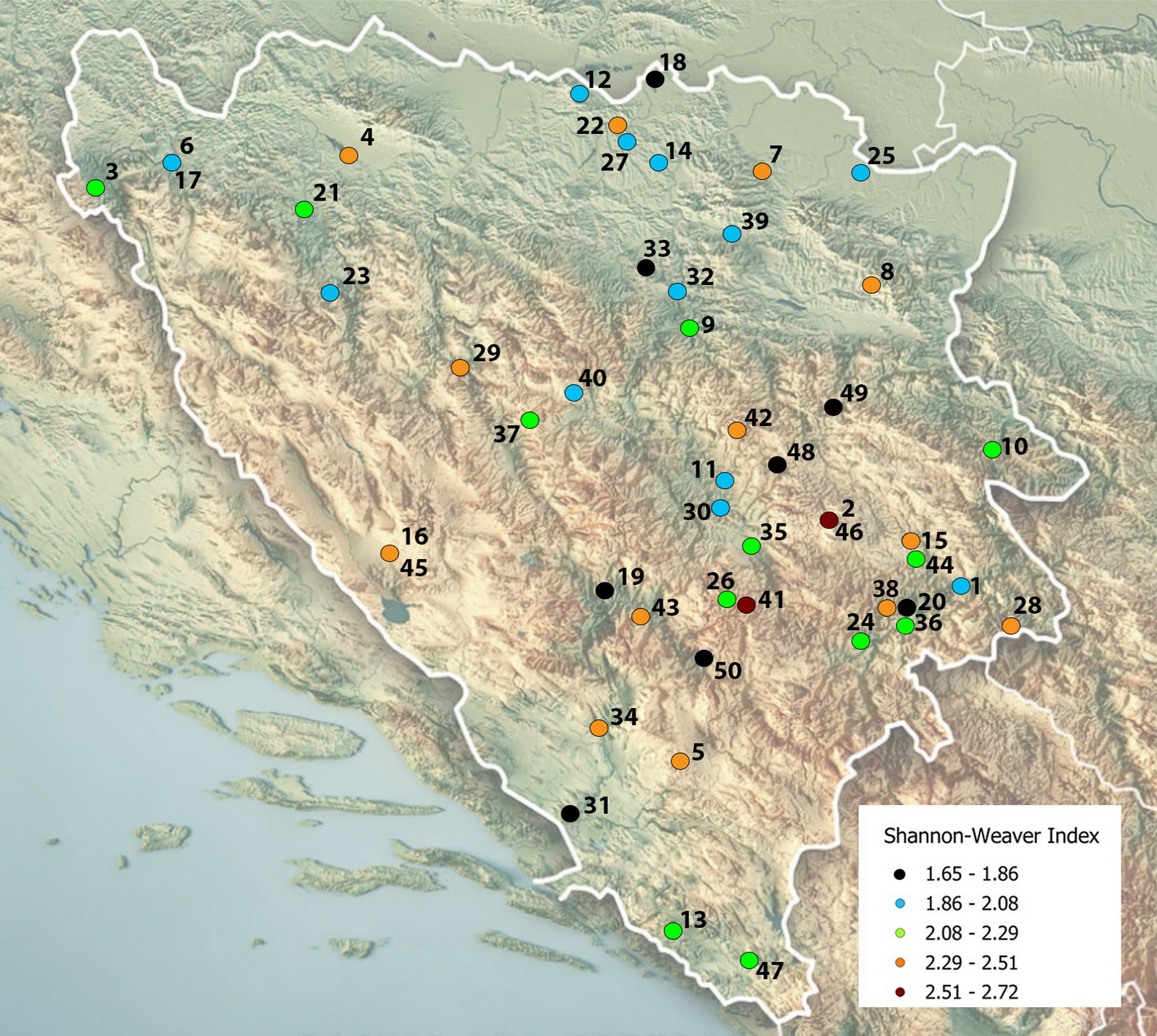
As part of the research, 50 polyfloral honey samples from Bosnia and Herzegovina (B&H) were collected and analyzed. The study aimed to determine the botanical specificity and degree of diversity of polyfloral honey originating from B&H. Melisopalynological preparations were prepared and interpreted by the Regulation on Methods for the Control of Honey and Other Bee Products of Bosnia and Herzegovina and methods proposed by the ICBB. Melissopalynological analysis revealed 15,000 pollen grains from 50 polyfloral honey samples and from 24 plant families. The most prominent number of pollen grains was from Fabaceae, Rosaceae and Asteraceae. Through the analysis of micromorphological characteristics, 51 different pollen types were identified. The Shannon-Weaver (H) index value of the analyzed samples were from 1.65 to 2.72, while the Shannon uniformity index (J') was from 0.7 to 1. Each analyzed palynological profile represents a unique combination of pollen from honey plants and reflects the floristic diversity of the apiflora B&H.
Prenosi
Literatura
Almasaudi, S.B., Al Namari, A.A., El Sayed, M., Barbour, E., Al Mumayayi, S. M., & Harakem, S. (2017). Antimicrobial effect of different types of honey on Staphylococcus aureus. Saudi Journal of Biological Sciences, 24(6), 1255-1261. https://doi.org/10.1016/j.sjbs.2016.08.007 DOI: https://doi.org/10.1016/j.sjbs.2016.08.007
Altay, V., Karahan, P., Karahan, F., & Öztürk, M. (2018). Pollen analysis of honeys from Hatay/Turkey. Biological Diversity and Conservation, 11(3), 209-222.
Atanacković Krstonošić, T.M., Cvejić Hogervorst, M.J., Krstonošić, S.V., & Mikulić, P.M. (2019). Phenolic content and in vitro antioxidant capacity of mono - and polyfloral honeys originating from Serbia. Food and Feed Research, 46(1), 83-89. https://doi.org/ 10.5937/FFR1901083A DOI: https://doi.org/10.5937/FFR1901083A
Balázs, V., Nagy-Radványi, L., Filep, R., Kerekes, E., Kocsis, B., Kocsis, M., & Farkas, Á. (2021). In Vitro Antibacterial and Antibiofilm Activity of Hungarian Honeys against Respiratory Tract Bacteria. Foods, 10(7), 1632. https://doi.org/10.3390/foods10071632 DOI: https://doi.org/10.3390/foods10071632
Balkanska, R., Stefanova, K., Stoikova-Grigorova, R., Gerginova, D., Simova S., & Atanassov, I. (2023). Assessment of the botanical origin of Bulgarian honey samples using melissopalynological, DNA barcoding and NMR analyses. Botanica Serbica, 47(1), 75-85. https://doi.org/10.2298/BOTSERB2301075B DOI: https://doi.org/10.2298/BOTSERB2301075B
Bhatta, R. V. (2022). Role of honey in human diet and health. In D. Das & P. Ghosh, (Eds.), Ethnobotany and ethanozoology (pp. 235-248). Bharti publications: New Delhi, India.
Britvec, M., Ljubičić, I., & Šimunić, R. (2013). Medonosno bilje kamenjarskih pašnjaka otoka Krka, Cresa i Paga. Agronomski glasnik, 75(1), 31-42.
Celebioglu, H. U., Erden, Y., & Ozel, H. B. (2021). In vitro cytotoxic effects of lactobacilli grown with lime honey on human breast and colon cancer cells. Food Bioscience, 41, 101020. https://doi.org/10.1016/j.fbio.2021.101020 DOI: https://doi.org/10.1016/j.fbio.2021.101020
Chen, K. W., Marusciac, L., Tamas, P.T., Valenta, R., & Panaitescu, C. (2018). Ragweed Pollen Allergy: Burden, Characteristics, and Management of an Imported Allergen Source in Europe. International Archives of Allergy and Immunology, 176, 163-180. https://doi.org 10.1159/000487997 DOI: https://doi.org/10.1159/000487997
Chiş, A. & Purcarea, C. (2011). Physico–Chemical Characterisation of Artisanal Lime Honey from Bihor County. Natural resources and sustainable development, 1, 81-88.
Conti, I., Medrzycki, P., Grillenzoni, V. F., Corvucci, F., Tosi, S., Malagnini, V., Spinella, M., & Mariotti G. M. (2016). Floral diversity of pollen collected by honey bees (Apis mellifera L.) – validation of the chromatic assessment method. Journal of Apicultural Science, 60(2), 209-220. https://doi.org/10.1515/jas-2016-0028 DOI: https://doi.org/10.1515/jas-2016-0028
Dugda, D., & Addi, A. (2024). Honeybee Floral Diversity of Gemachis Forest, West Hararghe Zone, Oromia Regional State, Ethiopia. Frontiers, 4(2), 55-67. https://doi.org/10.11648/j.frontiers.20240402.12 DOI: https://doi.org/10.11648/j.frontiers.20240402.12
Dujmović Purgar, D. & Hulina, N. (2007). The honey plants of Plešivica hills (NW Croatia). Agronomski glasnik, 69(1), 3-22.
Drešković, N., Đug, S., Stupar, V., Hamzić, A., Lelo, S., Muratović, E., Lukić-Bilela, L., Brujić, J., Milanović, Đ., Kotrošan, D. (2011). Natura 2000 u Bosni i Hercegovini. Centar za okolišno održivi razvoj. Sarajevo.
Đogo Mračević, S., Krstić, M., Lolić A., & Ražić S. (2020). Comparative study of the chemical composition and biological potential of honey from different regions of Serbia. Microchemical Journal, 152, 104420. https://doi.org/10.1016/j.microc.2019.104420 DOI: https://doi.org/10.1016/j.microc.2019.104420
Erdtman, G. (1943). An introduction to pollen analysis. Waltham, Mass., U.S.A.: Chronica Botanica Company.
Erdtman, G. (1952). Pollen morphology and plant taxonomy angiosperms. Waltham, Mass., U.S.A.: Chronica Botanica Company. DOI: https://doi.org/10.1080/11035895209453507
European Food Safety Authority (2010). Scientific Opinion on the effect on public or animal health or on the environment on the presence of seeds of Ambrosia spp. in animal feed. EFSA Journal, 8(6),1566. DOI: https://doi.org/10.2903/j.efsa.2010.1566
Gekić, H., Bidžan-Gekić, A., Drešković, N., Mirić, R., Reményi, P. (2022). The geography of Bosnia and Herzegovina. Between East and West. Springer Nature, Cham, Switzerland, pp. 1-130. https://doi.org/10.1007/978-3-030-98523-3. DOI: https://doi.org/10.1007/978-3-030-98523-3_8
Grimmett, R., Mrak, M., Orueta, J., Perry, E., Valderrabano, M., Valdez, C., & Wood, P., (2017). Ecosystem Profile. Mediterranean Basin Biodiversity Hotspot. BirdLife International.
Güneş, M. E. (2021). Chestnut Honey as a Complementary Medicine: Determination of Antibacterial Activity, Heavy Metal Residue and Health Risk Assessment. Journal of Advances in VetBio Science and Techniques, 6(2), 82-89. https://doi.org/10.31797/vetbio.931144 DOI: https://doi.org/10.31797/vetbio.931144
Haidamus, S. L., Affonso Lorenzon, M. C., Koshiyama, A. S., & Tassinari, W.D.S. (2019). Floral Diversity in Different Types of Honey. Brazilian Archives of Biology and Technology, 62, e19180241. https://doi.org/10.1590/1678-4324-2019180241. DOI: https://doi.org/10.1590/1678-4324-2019180241
Hailu, D. & Belay, A. (2020). Melissopalynology and antioxidant properties used to differentiate Schefflera abyssinica and polyfloral honey. PLoS ONE 15(10), e0240868. https://doi. org/10.1371/journal.pone.0240868 DOI: https://doi.org/10.1371/journal.pone.0240868
Herrmann, B., Cerbule, K., Brčić, J., Grimaldo, E., Geoffroy, M., Daase, M., & Berge, J. (2022). Accounting for Uncertainties in Biodiversity Estimations: A New Methodology and Its Application to the Mesopelagic Sound Scattering Layer of the High Arctic. Frontiers in Ecology and Evolution, 10. https:// doi=10.3389/fevo.2022.775759 DOI: https://doi.org/10.3389/fevo.2022.775759
Hesse, M., Halbritter, H., Zetter, R., Weber, M., Büchner, R., Frosch-Radivo, A., & Ulrich, S. (2009). Pollen Terminology An illustrated handbook. Wien, New York: Springer.
Homrani, M., Escuredo, O., Rodríguez-Flores, M. S., Fatiha, D., Mohammed, B., Homrani, A., & Seijo, M. C. (2020). Botanical Origin, Pollen Profile, and Physicochemical Properties of Algerian Honey from Different Bioclimatic Areas. Foods, 9(7), 938. https://doi.org/10.3390/foods9070938 DOI: https://doi.org/10.3390/foods9070938
Horčinová Sedláčková, V., Grygorieva, O., Fatrcová Šramková, K., Shelepova, O., Goncharovska, I., & Mňahončáková, E. (2021). The chemical composition of pollen, staminate catkins, and honey of Castanea sativa Mill. Potravinarstvo Slovak Journal of Food Sciences, 15, 433-444. https://doi.org/10.5219/1627 DOI: https://doi.org/10.5219/1627
Hulea, A., Obistioiu, D., Cocan, I., Alexa, E., Negrea, M., Neacsu, A.-G., Hulea, C., Pascu, C., Costinar, L., Iancu, I., Tirzui E., & Herman V. (2022). Diversity of Monofloral Honey Based on the Antimicrobial and Antioxidant Potential. Antibiotics, 11, 595. https://doi.org/ 10.3390/antibiotics11050595 DOI: https://doi.org/10.3390/antibiotics11050595
Ivanović, M., Galonja, Coghill, T., Janković, S., Rajković, B.M., Stanković, V., Paunović, D., & Zlatanović S. (2021). Analiza uzoraka organski proizvedenog meda i meda proizvedenog na konvencionalni način na području Zapadne Srbije. Zaštita materijala 62(1), 22-33. https://doi.org/10.5937/zasmat2101022I DOI: https://doi.org/10.5937/zasmat2101022I
Kanter, U., Heller, W., Durner, J., Winkler, J.B., Engel, M., Behrendt, H., Holzinger, A., Braun, P., Hauser, M., Ferreira, F., Mayer, K., Pfeifer, M., & Ernst, D. (2013). Molecular and Immunological Characterization of Ragweed (Ambrosia artemisiifolia L.) pollen after Exposure of the Plants to Elevated Ozone over a Whole Growing Season. PLoS One, 8(4), e61518- e61518. https://doi.org/10.1371/journal.pone.0061518 DOI: https://doi.org/10.1371/journal.pone.0061518
Khushdil Khan, Khafsa Malik, Mushtaq Ahmad, Rahmatullah Qureshi, Muhammad Asif Aziz, Safia Gul, Wahidah H. Al-Qahtani, & Raees Khan, (2024). Diversity of melliferous Flora (Apiaries) in Honey and microscopic authentication using LM and SEM Techniques. Flora, 312, 152477. https://doi.org/10.1016/j.flora.2024.152477. DOI: https://doi.org/10.1016/j.flora.2024.152477
Kolayli, S., Palabiyik, I., Atik, D.S., Keskin, M., Bozdeveci, A., & Karaoglu, S.A. (2020). Comparison of Antibacterial and Antifungal Effects of Different Varieties of Honey and Propolis Samples. Acta Alimentaria AAlim, 49(4), 515-523. https://doi.org/10.1556/066.2020.49.4.18 DOI: https://doi.org/10.1556/066.2020.49.4.18
Louveaux, J., Maurizio, A., & Vorwohl, G. (1978). Methods of Melissopalynology. Bee World, 59, 139-157. DOI: https://doi.org/10.1080/0005772X.1978.11097714
Ljevnaić-Mašić, B., Nikolić, LJ., Džigurski, D., Ratkov, T., Popov, M., & Pihler, I. (2019). Medonosne biljke u kanalskoj mreži Banata. Acta Herbologica, 28(2), 133-144. https://doi.org/10.5937/ActaHerb1902133L DOI: https://doi.org/10.5937/ActaHerb1902133L
Mačukanović-Jocić M. & Jarić S. (2015). The melliferous potential of apiflora of southwestern Vojvodina (Serbia). Archives of Biological Sciences, 68(1), 81-91. https://doi.org/10.2298/ABS150427130M DOI: https://doi.org/10.2298/ABS150427130M
Magurran, A. E. (2013). Measuring biological diversity. John Wiley & Sons, Hoboken.
McLoone, P., Zhumbayeva, A., Yunussova, S., Kaliyev, Y., Yevstafeva, L., Verrall, S., Sungurtas, J., Austin, C., Allwood, J.W., & McDougall, G.J. (2021). Identification of components in Kazakhstan honeys that correlate with antimicrobial activity against wound and skin infecting microorganisms. BMC complementary medicine and therapies, 21(1), 300. https://doi.org/10.1186/s12906-021-03466-0 DOI: https://doi.org/10.1186/s12906-021-03466-0
Pătruică, S., Alexa, E., Obiștioiu, D., Cocan, I., Radulov, I., Berbecea, A., Lazăr, R.N., Simiz, E., Vicar, N.M., Hulea, A., & Moraru D. (2022). Chemical Composition, Antioxidant and Antimicrobial Activity of Some Types of Honey from Banat Region, Romania. Molecules, 27(13), 4179. https://doi.org/10.3390/molecules27134179 DOI: https://doi.org/10.3390/molecules27134179
Pešić, V. & Tomović L. (2011). Praktikum iz ekologije. Univerzitet Crne Gore, Podgorica.
Pupuleku, B., Kapidani, G., Naqellari, P., & Gjeta E. (2016). Melissopaynological Study of Albania’s Honey. Academic Journal of Interdisciplinary Studies, 5, 261-268. https://doi.org/10.5901/ajis.2016.v5n3s1p261 DOI: https://doi.org/10.5901/ajis.2016.v5n3s1p261
Ramić, D., Gobin, I., Vučković, D., Planinić, A., Brčić Karačonji, I., & Smole Možina, S. (2023). Fir (Abies alba Mill.) Honeydew Honey Inhibits Growth and Adhesion of Campylobacter jejuni In Vitro. Applied Sciences, 13(23), 12735. https://doi.org/10.3390/app132312735 DOI: https://doi.org/10.3390/app132312735
Rašić, S., Štefanić, E., Antunović, S., Jović, J. i Kristek, S. (2018). Pollen analysis of honey from north-eastern Croatia. Poljoprivreda, 24(2), 43-49. https://doi.org/10.18047/poljo.24.2.6 DOI: https://doi.org/10.18047/poljo.24.2.6
RBB&H (2009). Rulebook on Methods for the Control of Honey and Other Bee Products of Bosnia and Herzegovina. Official Gazette, 37/09.
Redžić, S. (2007). The ecological aspect of ethnobotany and ethnopharmacology of population in Bosnia and Herzegovina. Collegium Antropologicum, 31(3), 869-890.
Redžić, S., Barudanović, S., Radević, M. (2008). Bosna i Hercegovina – zemlja raznolikosti. Federalno ministarstvo okoliša i turizma, Sarajevo.
Rojo, S., Escuredo, O., Rodríguez-Flores, M. S., & Seijo, M. C. (2023). Botanical Origin of Galician Bee Pollen (Northwest Spain) for the Characterization of Phenolic Content and Antioxidant Activity. Foods, 12(2), 294. https://doi.org/10.3390/foods12020294 DOI: https://doi.org/10.3390/foods12020294
Shakoori, Z., Salaseh, E., Mehrabian, A.R., Tehrani M. D., Dardashti, F. N., & Salmanpour F. (2024). The amount of antioxidants in honey has a strong relationship with the plants selected by honey bees. Scientific Reports, 14, 351. https://doi.org/10.1038/s41598-023-51099-9 DOI: https://doi.org/10.1038/s41598-023-51099-9
Shannon, C. E. (2001). A mathematical theory of communication. ACM SIGMOBILE Mobile Computing and Communications Review, 5(1), 3-55. DOI: https://doi.org/10.1145/584091.584093
Song, X.-Y., Yao, Y.-F., & Yang, W.-D. (2012). Pollen Analysis of Natural Honeys from the Central Region of Shanxi, North China. PLoS ONE, 7(11), e49545. https://doi.org/10.1371/journal.pone.0049545 DOI: https://doi.org/10.1371/journal.pone.0049545
Štefanić, E., Zima, D., Rašić, S., Radović, V. (2013). Botaničko porijeklo meda Požeške kotline. Proceedings, 47th Croatian and 7th International Symposium on Agriculture, 629-633.
Tasić, A., Pezo, L., Lončar, B., Pešić, M.B., Tešić, Ž., & Kalaba, M. (2024). Assessing the Impact of Botanical Origins, Harvest Years, and Geographical Variability on the Physicochemical Quality of Serbian Honey. Foods, 13(10), 1530. https://doi.org/10.3390/foods13101530 DOI: https://doi.org/10.3390/foods13101530
Tomczyk, M., Tarapatskyy, M., & Džugan, M. (2019). The influence of geographical origin on honey composition studied by Polish and Slovak honeys. Czech Journal of Food Sciences, 37(4), 232-238. https://doi.org/10.17221/40/2019-CJFS DOI: https://doi.org/10.17221/40/2019-CJFS
Topal, A., Uzun A., & Polat, O. (2023). Apifloristic diversity in the eastern Mediterranean region: implications for biodiversity conservation and use. Archives of Biological Sciences, 75(2), 221-236. https://doi.org/10.2298/ABS230331018T DOI: https://doi.org/10.2298/ABS230331018T
Villalpando-Aguilar, J.L., Quej-Chi, V.H., López-Rosas, I., Cetzal-Ix, W., Aquino-Luna, V.Á., Alatorre-Cobos, F., Martínez-Puc, J.F. (2022). Pollen Types Reveal Floral Diversity in Natural Honeys from Campeche, Mexico. Diversity, 14(9), 740. https://doi.org/10.3390/d14090740 DOI: https://doi.org/10.3390/d14090740
Von Der Ohe, W., Persano Oddo, L., Piana, M. L., Morlot, M., & Martin, P. (2004). Harmonized methods of melissopalynology. Apidologie, 35, 18-25. https://doi.org/10.1051/apido:2004050 DOI: https://doi.org/10.1051/apido:2004050
Yildirim E. A., Karlioğlu Kiliç N., & Özkan N. G. (2021). Pollen analysis of honeys from Yığılca region (Düzce), Turkey. Eurasian Journal of Forest Science, 9(3), 259-271. https://doi.org/10.3195/ejejfs.1001338 DOI: https://doi.org/10.31195/ejejfs.1001338
Zima, D. (2007). Prilog poznavanju medonosnog bilja. Agronomski glas
Prenosi
Objavljeno
Kako citirati
Številka
Rubrike
Licenca
Avtorske pravice (c) 2025 ZRC-SAZU

To delo je licencirano pod Creative Commons Priznanje avtorstva 4.0 mednarodno licenco.
Avtorji jamčijo, da je delo njihova avtorska stvaritev, da v njem niso kršene avtorske pravice tretjih oseb ali kake druge pravice. V primeru zahtevkov tretjih oseb se avtorji zavezujejo, da bodo varovali interese založnika ter da bodo povrnili morebitno škodo.
Podrobneje v rubriki: Prispevki