
Soil pH as a strong driver of plant species distribution in alpine-nival ecotone of the Central Caucasus
DOI:
https://doi.org/10.3986/hacq-2025-0022Keywords:
community assembly, regional patterns of species distribution, the climate and bedrock, environmental gradientAbstract
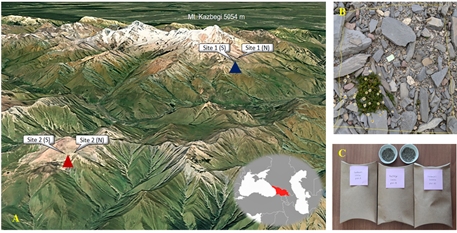
Soil pH can be a strong driver of species distributions in general, however, its role in alpine-nival ecotone is little known. We compared the composition of plant species of two locations located 25km apart from each other, one near Mt. Kazbegi and another near Mt. Gudauri (Georgia). These locations have similar abiotic environments but significantly different soil pH levels. The sampled communities were located at 3000 m a.s.l., which in the Central Caucasus corresponds to the alpine-nival ecotone. North- versus south-facing slopes were sampled with a standardized stratified-random design. Soil samples were collected from the same vegetation sampling plots. The analysis of climate data from available databases showed that these two locations were climatically similar but distinguishable in soil pH values. In total, 74 species were recorded, of which the relatively frequent 33 species (those with a frequency of occurrence ≥10) were used for multivariate statistical analyses. The floristic similarity between the locations was low. Axis 1, which was primarily linked to soil pH and, to a lesser extent, vegetation cover, accounted for nearly all the variation in the Canonical Correlation Analysis (CCA) ordination. Our results suggest that soil pH is a key factor in community assembly in the alpine-nival ecotone of the Central Caucasus.
Downloads
References
Abdaladze, O., Nakhutsrishvili, G., Batsatsashvili, K., Gigauri, Kh, Jolokhava, T., & Mikeladze, G. (2015). Sensitive alpine plant communities to the global environmental changes (Kazbegi region, the Central Great Caucasus). American Journal of Environmental Protection, 4 (3-1), 93-100. https://doi: 10.11648/j.ajep.s.2015040301.25. DOI: https://doi.org/10.11648/j.ajep.s.2015040301.25
Adamia, S., Alania, V., Chabukiani, A., Chichua, G., Enukidze, O., & Sadradze, N. (2010). Evolution of the Late Cenozoic basins of Georgia (SW Caucasus): a review. Geological Society, London, Special Publications, 340(1), 239-259. DOI: https://doi.org/10.1144/SP340.11
Anderson, M.J., Crist, T.O., Chase, J.M., Vellend, M., Inouye, B.D., Freestone, A.L., Sanders, N.J., Cornell, H.V., Comita, L.S., Davies, K.F. & Harrison, S.P. 2011. Navigating the multiple meanings of β diversity: a roadmap for the practicing ecologist. Ecology Letters, 14 (1), 19-28. https://doi.org/10.1111/j.1461-0248.2010.01552.x DOI: https://doi.org/10.1111/j.1461-0248.2010.01552.x
Beals, E. W. (1984). Bray-Curtis ordination: an effective strategy for analysis of multivariate ecological data. In Advances in ecological research (Vol. 14, pp. 1-55). Academic Press. https://doi.org/10.1016/S0065-2504(08)60168-3 DOI: https://doi.org/10.1016/S0065-2504(08)60168-3
Braun-Blanquet, J., & Jenny, H. (1926). Vegetation development and soil formation in the alpine region of the Central Alps (climax area of Caricion curvulae). Memories of the Swiss Society of Natural Sciences, 36 (2), 185-349. (in German)
Buri, A., Grand, S., Yashiro, E., Adatte, T., Spangenberg, J.E.,Pinto-Figueroa, E., Verrecchia, E., & Guisan, A. (2020). What are the most crucial soil variables for predicting the distribution of mountain plant species? A comprehensive study in the Swiss Alps. Journal of Biogeography, 47 (5), 1143–1153. https://doi.org/10.1111/jbi.13803 DOI: https://doi.org/10.1111/jbi.13803
Chytrý, M., Danihelka, J., Ermakov, N., Hájek, M., Hájková, P., & Kočí, M. (2007). Plant species richness in continental southern Siberia: effects of pH and climate in the context of the species pool hypothesis. Global Ecology and Biogeography, 16 (5), 668–678. https://doi.org/10.1111/j.1466-8238.2007.00320.x DOI: https://doi.org/10.1111/j.1466-8238.2007.00320.x
Chytrý, M., Tichý, L., & Roleček, J. (2003). Local and regional patterns of species richness in Central European vegetation types along the pH/calcium gradient. Folia Geobotanica, 38, 429-442. https://doi.org/10.1007/BF02803250 DOI: https://doi.org/10.1007/BF02803250
De Frenne, P., Rodríguez-Sánchez, F., Coomes, D. A., Baeten, L., Verstraeten, G., Vellend, M., Bernhardt-Römermann, M., Brown, C.D., Brunet, J., Cornelis, J., Decocq, G.M. (2013). Microclimate moderates plant responses to macroclimate warming. Proceedings of the National Academy of Sciences, 110 (46), 18561-18565.
Egli, M., Fitze, P., & Mirabella, A. (2001). Weathering and evolution of soils formed on granitic, glacial deposits: results from chronosequences of Swiss alpine environments. Catena, 45 (1), 19-47. https://doi.org/10.1016/S0341-8162(01)00138-2 DOI: https://doi.org/10.1016/S0341-8162(01)00138-2
Erschbamer, B., Mallaun, M., Unterluggauer, P., Abdaladze, O., Akhalkatsi, M., & Nakhutsrishvili, G., 2010. Plant diversity along altitudinal gradients in the central Alps (South Tyrol, Italy) and in the central greater Caucasus (Kazbegi region, Georgia).Tuexenia, 30 (1), 11-29.
Foth, H. D. (1978). Fundamentals of soil science. Soil Science, 125(4), 272. DOI: https://doi.org/10.1097/00010694-197804000-00021
Frei, E., Bodin, J., & Walther, G. R. (2010). Plant species’ range shifts in mountainous areas—all uphill from here? Botanica Helvetica, 120: 117-128. https://doi.org/10.1016/B978-0-12-590655-5.X5001-4 DOI: https://doi.org/10.1007/s00035-010-0076-y
Gagnidze, R. (2005). Vascular Plants of Georgia a Nomen-clatural Checklist; Georgian Academy of Sciences, N. Ketskhoveli, Institute of Botany, Tbilisi.
Gamkrelidze, I. P. (1986). Geodynamic evolution of the Caucasus and adjacent areas in Alpine time. Tectonophysics, 127(3-4), 261-277. DOI: https://doi.org/10.1016/0040-1951(86)90064-8
Gigauri, Kh., Abdaladze, O., Bakhia, A., Asanidze, Z., & Mamedova, A. (2021). The first results of the 3rd cycle of Global Monitoring GLORIA Network of the Central Great Caucasus. Bocconea, 29: 103-119. https://doi.org/10.7320/Bocc29.103. DOI: https://doi.org/10.7320/Bocc29.103
Gigauri, Kh, Akhalkatsi, M., Nakhutsrishvili, G., & Abdaladze, O. 2013. Monitoring of vascular plant diversity in a changing climate in the alpine zone of the Central Caucasus. Turkish Journal of Botany 37 (6), 1104–1114. https://doi.org/10.3906/bot-1301-38 DOI: https://doi.org/10.3906/bot-1301-38
Gigauri, Kh., Abdaladze, O., Nakhutsrishvili, G., & Akhalkatsi, M. (2014). Vascular plant diversity and climate change in the alpine zone of the Central Greater Caucasus. International Journal of Ecosystems and Ecology Science, 4(4), 573–589.
Gigauri, Kh., Akhalkatsi, M., Abdaladze, O., & Nakhutsrishvili, G. (2016). Alpine plant distribution and thermic vegetation indicator on GLORIA summits in the Central Greater Caucasus. Pakistan Journal of Botany 48 (50), 1893–1902.
Goodenough, A. E., & Webb, J. C. (2022). Learning from the past: opportunities for advancing ecological research and practice using palaeoecological data. Oecologia, 199(2), 275-287. https://doi.org/10.1007/s00442-022-05190-z DOI: https://doi.org/10.1007/s00442-022-05190-z
Gottfried, M., Pauli, H., Futschik, A., Akhalkatsi, M., Barančok, P., Benito Alonso, J.L., Coldea, G., Dick, J., Erschbamer, B., Fernández Calzado, M.A.R., & Kazakis, G. (2012). Continent-wide response of mountain vegetation to climate change. Nature Climate Change, 2(2), 111-115. https://doi.org/10.1038/nclimate1329 DOI: https://doi.org/10.1038/nclimate1329
Grabherr, G., Gottfried, M., & Pauli, H. (2010). Climate change impacts in alpine environments. Geography Compass, 4(8), 1133-1153. https://doi.org/10.1111/j.1749-8198.2010.00356.x DOI: https://doi.org/10.1111/j.1749-8198.2010.00356.x
Hanauer, T., Grzelachowski, T., Vashev, B., Böhm, L., Heyde, B. J., Kalandadze, B., Urushadze, T., & Felix-Henningsen, P. (2023). Soil distribution and soil properties in the subalpine region of Kazbegi, Greater Caucasus, Georgia: Physicochemical properties, distribution and genesis. Geoderma Regional, 35, e00734. https://doi.org/10.1016/j.geodrs.2023.e00734 DOI: https://doi.org/10.1016/j.geodrs.2023.e00734
Hubálek, Z., & Horáková, M. (1988). Evaluation of climatic similarity between areas in biogeography. Journal of Biogeography, 1: 409-418. https://doi.org/10.2307/2845272 DOI: https://doi.org/10.2307/2845272
Ismail-Zadeh, A., Adamia, S., Chabukiani, A., Chelidze, T., Cloetingh, S., Floyd, M., Gorshkov, A., Gvishiani, A., Ismail-Zadeh, T., Kaban, M.K., & Kadirov, F. (2020). Geodynamics, seismicity, and seismic hazards of the Caucasus. Earth-Science Reviews, 1, 207:103222 DOI: https://doi.org/10.1016/j.earscirev.2020.103222
Jackson, M. L. (1969). Soil chemical analysis-advanced course.
Jenny, H. (1994). Factors of soil formation: a system of quantitative pedology. Courier Corporation.
Ji, C.J., Yang, Y.H., Han, W.X., He, Y.F., Smith, J., & Smith, P. 2014. Climatic and edaphic controls on soil pH in alpine grasslands on the Tibetan Plateau, China: a quantitative analysis. Pedosphere, (24)1: 39–44. https://doi.org/10.1016/S1002-0160(13)60078-8 DOI: https://doi.org/10.1016/S1002-0160(13)60078-8
Jolokhava, T., Abdaladze, O., Gadilia, Sh., & Kikvidze, Z. (2020). Variable soil pH can drive changes in the slope aspect preference of plants in alpine desert of the Central Great Caucasus (Kazbegi district, Georgia). Acta Oecologica, 105:103582. 103582.https://doi.org/10.1016/j.actao.2020.103582 DOI: https://doi.org/10.1016/j.actao.2020.103582
Jolokhava, T., Abdaladze, O., Gigauri, Kh., & Kikvidze, Z. (2021). Gradient analysis of soil-plant interactions from the alpine-nival ecotone to the snowline on slopes of the Central Great Caucasus (Kazbegi Region, Georgia). Ukrainian Botanical Journal, 78(3), 163-175. https://doi.org/10.15407/ukrbotj78.03.163 DOI: https://doi.org/10.15407/ukrbotj78.03.163
Kemmitt, S. J., Wright, D., Goulding, K. W., & Jones, D. L. (2006). pH regulation of carbon and nitrogen dynamics in two agricultural soils. Soil Biology and Biochemistry, 38 (5), 898-911. https://doi.org/10.1016/j.soilbio.2005.08.006 DOI: https://doi.org/10.1016/j.soilbio.2005.08.006
Kent, M. (2011). Vegetation description and data analysis: a practical approach. John Wiley & Sons.
Kikvidze, Z., Jolokhava, T., Bakhia, A., & Abdaladze, O. (2020). Jumping the barrier: does a glacier tongue affect species distribution along the elevation gradient in the subnival and nival belts? A case study on Mt. Kazbegi, Georgia, Central Great Caucasus Mountains. Botanica Serbica, 44(2), 219-229. https://doi.org/10.2298/BOTSERB2002219K DOI: https://doi.org/10.2298/BOTSERB2002219K
Körner, C. (2003). Alpine plant life: functional plant ecology of high mountain ecosystems; with 47 tables. Springer Science & Business Media. https://doi.org/10.1007/978-3-642-18970-8 DOI: https://doi.org/10.1007/978-3-642-18970-8
Maruashvili, L. (1969). Physical Geography of Georgia. Publishing house of Ivane Javakhishvili Tbilisi State University, Part. I. (in Georgian).
De Frenne, P., Rodríguez-Sánchez, F., Coomes, D. A., Baeten, L., Verstraeten, G., Vellend, M., ... & Verheyen, K. (2013). Microclimate moderates plant responses to macroclimate warming. Proceedings of the National Academy of Sciences, 110(46), 18561-18565. https://doi.org/10.1073/pnas.1311190110 DOI: https://doi.org/10.1073/pnas.1311190110
Milanovsky, E., & Koronovsky, N. (19730. Orogenic Volcanism and Tectonics of the Alpine Belt of Eurasia Nauka, Moscow, 277 p. (in Russian)
Molau, U. (2003). Overview: patterns in diversity (pp. 125-132). Springer Berlin Heidelberg. https://doi.org/10.1007/978-3-642-18967-8_4 DOI: https://doi.org/10.1007/978-3-642-18967-8_4
Nakhutsrishvili, G. 1971. Ecology of High Mountain Herbaceous Plants and Phytocenoses of the Central Caucasus – Water Regime. Metsniereba, Tbilisi, 199 p. (in Russian)
Nakhutsrishvili, G. (2012). The vegetation of Georgia (South Caucasus). Springer Science & Business Media. https://doi.org/10.1007/978-3-642-29915-5 DOI: https://doi.org/10.1007/978-3-642-29915-5_6
Nakhutsrishvili, G., & Abdaladze, O. (2017). Vegetation of the Central Great Caucasus along WE and NS transects. Plant diversity in the Central Great Caucasus: a quantitative assessment, 11-16.https://doi.org/10.1007/978-3-319-55777-9_2 DOI: https://doi.org/10.1007/978-3-319-55777-9_2
Nakhutsrishvili, G., Abdaladze, O., & Akhalkatsi, M. (2004). Global warming and treeline. Proceedings of the Georgian Academy of Sciences, 2, 101-103
Parmesan, C., & Yohe, G. (2003). A globally coherent fingerprint of climate change impacts across natural systems. Nature, 421 (6918), 37-42. https://doi.org/10.1038/nature01286 DOI: https://doi.org/10.1038/nature01286
Poulenard, J., & Podwojewski, P. (2006). Alpine soils. Encyclopedia of Soil Science, New York, Marcel Dekker, 7579 p. DOI: https://doi.org/10.1201/NOE0849338304.ch17
Robson, A. D. (1989). Soil acidity and plant growth. Academic Press, Sydney. 306 p. https://doi.org/10.1016/B978-0-12-590655-5.X5001-4 DOI: https://doi.org/10.1016/B978-0-12-590655-5.X5001-4
Schuster, B., & Diekmann, M. (2003). Changes in species density along the soil pH gradient—evidence from German plant communities. Folia Geobotanica, 38, 367-379. https://doi.org/10.1007/BF02803245 DOI: https://doi.org/10.1007/BF02803245
Skhirtladze, N. I. (1958). Postpaleogene Effusive Volcanism of Georgia. Tbilisi Publishers, Academy Science, Tbilisi. (in Russian)
Tan, K. H. (2005). Soil sampling, preparation, and analysis. CRC press. https://doi.org/10.1201/9781482274769 DOI: https://doi.org/10.1201/9781482274769
Townend, J. (2013). Practical statistics for environmental and biological scientists. John Wiley & Sons.
Tsereteli, N., Tibaldi, A., Alania, V., Gventsadse, A., Enukidze, O., Varazanashvili, O., & Müller, B. I. R. (2016). Active tectonics of central-western Caucasus, Georgia. Tectonophysics, 691, 328-344. https://doi.org/10.1016/j.tecto.2016.10.025 DOI: https://doi.org/10.1016/j.tecto.2016.10.025
Urushadze, T. F., Blum, W. E., Machavariani, J. S., Kvrivishvili, T. O., & Pirtskhalava, R. D. (2015). Soils of Georgia and problems of their use. Annals of Agrarian Science, 13(4).
Urushadze, T., & Ghambashidze, G. O. (2013). Soil Ressources of Georgia. Soil Resources of Mediterranean and Caucasus Countries, Scientific and Technical Research Series. Publications Office of the European Union. Luxembourg, pp.1-244.
Urushadze, T. (1989). Mountain Soils of the USSR. Publisher house Agropromizdat, Moscow. 247 p. (in Russian)
Urushadze, T. (1997). Major Soils of Georgia. Metsniereba, Tbilisi, 267 p. (in Georgian)
Urushadze, T., & Kvrivishvili, T. (2014). Guide on Soils in Georgia. Mtsignobari, Tbilisi, 133 p.(in Georgian)
Van Breemen, N., & Finzi, A. C. (1998). Plant-soil interactions: ecological aspects and evolutionary implications. Biogeochemistry, 42: 1-19. https://doi.org/10.1023/A:1005996009413 DOI: https://doi.org/10.1007/978-94-017-2691-7_1
Vonlanthen, C. M., Kammer, P. M., Eugster, W., Bühler, A., & Veit, H. 2006. Alpine vascular plant species richness: the importance of daily maximum temperature and pH. Plant Ecology, 184: 13-25. https://doi.org/10.1007/s11258-005-9048-5 DOI: https://doi.org/10.1007/s11258-005-9048-5
Downloads
Published
How to Cite
Issue
Section
License
Copyright (c) 2025 ZRC-SAZU

This work is licensed under a Creative Commons Attribution 4.0 International License.
Authors guarantee that the work is their own original creation and does not infringe any statutory or common-law copyright or any proprietary right of any third party. In case of claims by third parties, authors commit their self to defend the interests of the publisher, and shall cover any potential costs.
More in: Submission chapter